

ForceBeyond Logo
Secondary operations for cast, forged, and machined metal components

Secondary Operations for Castings, Forgings & Machined Components

Integrated Secondary Operations for Metal Components

ForceBeyond provides a complete suite of advanced secondary operations and post-processing services for custom castings, forgings, and machined components. While primary casting and forging processes create the near-net shape of a part, high-performance applications require secondary processing to achieve exact print tolerances, eliminate internal defects, optimize mechanical hardness, and prevent environmental corrosion.

Operating under a strict ISO 9001:2015 quality management system, ForceBeyond manages the entire post-forming value chain. Through our Tier-1.5 Manufacturing Model, we eliminate supply chain fragmentation and dimensional "hand-off" risks by integrating precision CNC machining, specialized heat treatment, Hot Isostatic Pressing (HIP), and advanced surface finishing under a single unified quality umbrella.

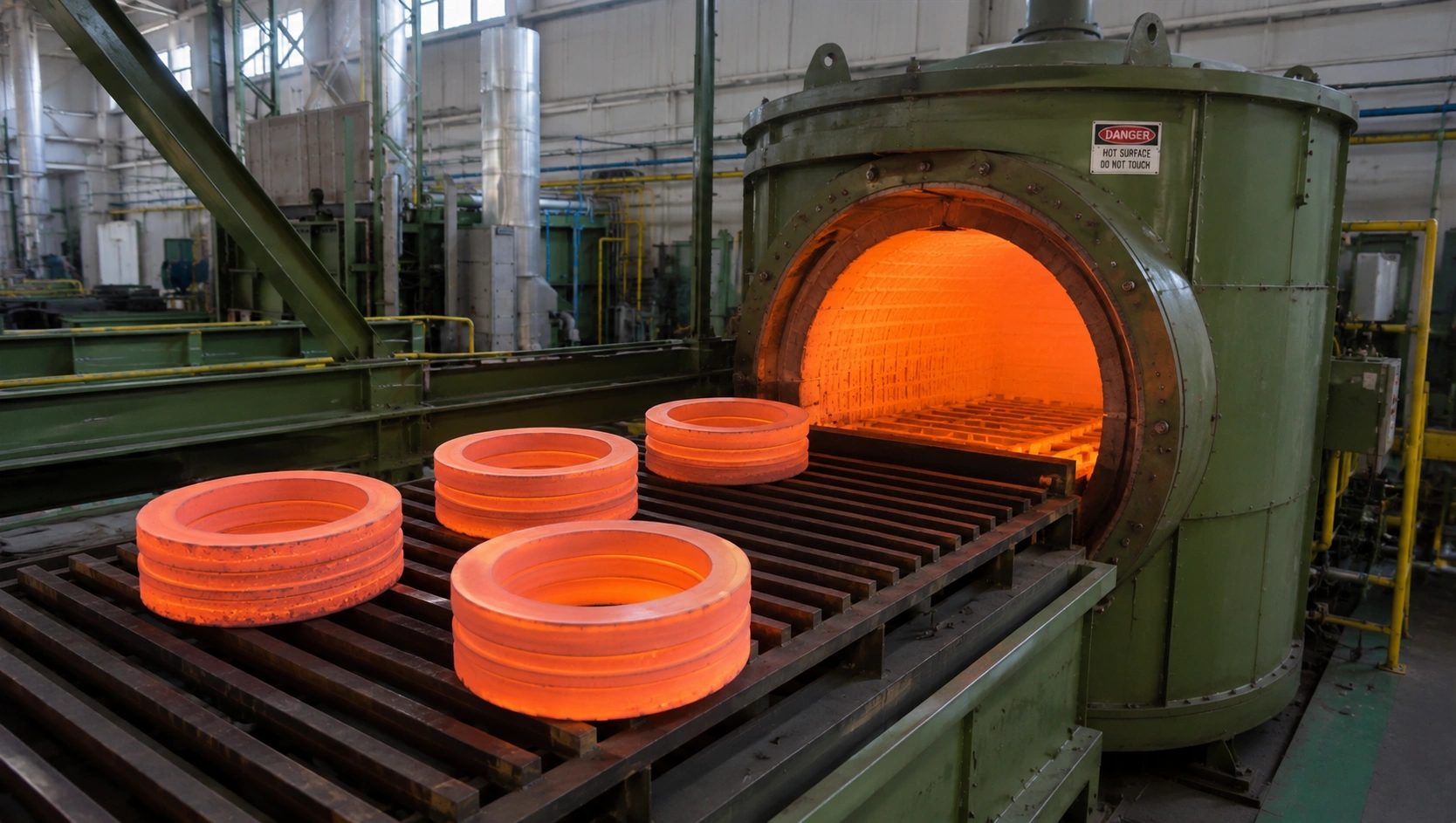
Four glowing metal rings undergoing industrial heat treatment beside an open high-temperature furnace in a manufacturing facility
---

How Secondary Operations Are Planned

In traditional manufacturing, managing separate vendors for casting, forging, CNC machining, thermal processing, and plating creates severe quality and schedule risks. When a part arrives out of specification, separate suppliers often blame one another.

  • Starting condition: as-cast, as-forged, heat-treated, billet-machined, or fabricated components require different process sequences.
  • Critical features: datum surfaces, sealing faces, bearing fits, threaded holes, bores, and GD&T controls determine machining and inspection strategy.
  • Mechanical properties: hardness, yield strength, ductility, residual stress, and fatigue performance influence heat-treatment selection.
  • Surface environment: corrosion, abrasion, temperature, chemical exposure, and cleanliness requirements determine the finishing route.
  • Documentation: first-article reports, material test reports, heat-treatment records, coating certificates, and inspection results should be defined before production.
---

Core Secondary Operations Capabilities

Our secondary operations are organized into four specialized disciplines, engineered to transform raw castings and forgings into mission-critical, assembly-ready parts:

Secondary Operation Primary Purpose Representative Capabilities
Precision CNC Machining Achieves exact dimensional tolerances, true positions, and threaded features. 5-axis CNC milling, multi-axis turning, Swiss-style machining, wire EDM, and micro-grinding.
Heat Treatment Alters the metallurgical grain structure to optimize hardness, strength, and ductility. Solution annealing, quenching, tempering, T6 artificial aging, stress relieving, and precipitation hardening.
Hot Isostatic Pressing (HIP) Eliminates internal micro-porosity and shrinkage voids in high-stress castings. Simultaneous extreme heat and 15,000+ psi argon gas pressure to achieve near-forged mechanical fatigue density.
Surface Finishing & Coating Protects against corrosion, wear, and chemicals while improving visual appearance. Chemical passivation, electropolishing, anodizing (Type II & III), e-coating, powder coating, and chrome plating.
---

1. Precision CNC Machining

While investment casting, die casting, and forging produce exceptional near-net-shape geometries, secondary CNC machining is essential for features requiring sub-micron accuracy, ultra-smooth sealing faces, concentric bearing journals, and threaded holes.

  • Material Expertise: Specialized in high-speed, rigid machining of hard-to-cut metals, including Inconel 718, Titanium (Ti-6Al-4V), Duplex 2205/2507 (Duplex Stainless Steel), 17-4 PH Stainless (Stainless Steel Casting), and ECO BRASS®.
  • Capabilities: Multi-axis 5-axis CNC milling, live-tool turning, Swiss turning for micro-components, and precision surface/cylindrical grinding.

Learn more about precision machining services and multi-axis CNC milling and turning.

---

2. Thermal Processing & Heat Treatment

Post-forming heat treatment is critical to relieving internal stresses, increasing yield strength, or softening work-hardened alloys for subsequent machining passes. ForceBeyond strictly controls furnace atmospheres and ramp rates to prevent scaling or oxidation.

  • Key Thermal Cycles: Solution Annealing (for stainless and superalloys), Quench & Tempering (for alloy steel - see Carbon & Low-Alloy Steel Casting), T6 Heat Treatment (for A356 aluminum), and Precipitation Age Hardening (for 17-4 PH and Inconel 718 featured in our superalloy forging services).
  • Atmospheric Control: Vacuum heat treating, inert gas atmospheres, and specialized induction hardening.
---

3. Hot Isostatic Pressing (HIP)

For mission-critical castings subjected to extreme pressure, rotational stress, or cyclic fatigue, internal microporosity is a primary failure point. Hot Isostatic Pressing (HIP) subjects cast parts to simultaneous elevated temperatures and intense, uniform gas pressure (typically argon at 15,000+ psi).

  • Metallurgical Healing: The combined heat and pressure cause internal microscopic voids and shrinkage pores to collapse and diffusion-weld closed.
  • Result: Transforms investment and sand castings into fully dense components with mechanical properties and fatigue life that rival wrought forgings (such as closed die forging or open die forging). Critical for aerospace turbine castings and nuclear hardware.
---

4. Surface Finishing & Protective Coatings

Extending the operational lifespan of a metal component requires protective surface treatments engineered for its specific working environment—whether marine saltwater, high-temperature exhaust, or sterile medical fluids.

  • Chemical Treatments: Citric and Nitric Passivation (ASTM A967) for stainless steel, and Electropolishing for ultra-clean sanitary/medical applications.
  • Anodizing & Plating: Type II & III Hardcoat Anodizing for aluminum (Aluminum Die Casting) / magnesium (Magnesium Casting), Chrome Plating for zinc (Zinc Die Casting) / brass, and Electroless Nickel Plating.
  • Barrier Coatings: Electro-deposition Coating (E-Coating), industrial liquid painting, and durable Powder Coating.
---

Inspection, NDT and Documentation

Quality planning should verify the effects of each secondary operation rather than inspecting only the final dimensions. Available support may include:

  • Radiographic Testing (RT): X-ray inspection (ASTM E192/E1030) to verify zero internal shrinkage or porosity before and after HIP.
  • Fluorescent Penetrant Inspection (FPI): Liquid penetrant testing (ASTM E1417) to detect surface-breaking cracks or pores on machined and cast surfaces.
  • Ultrasonic Testing (UT): High-frequency sound wave inspection (ASTM A388) to verify internal soundness across thick-section forgings and shafts (such as Rolled Ring Forging).
  • Full Documentation: Every shipment is accompanied by complete documentation, including Material Test Reports (MTRs), dimensional CMM reports, and heat-treat charts.

Frequently Asked Questions: Secondary Operations

What are secondary operations in metal manufacturing?

Secondary operations are the machining, heat treatment, finishing, inspection, assembly, and packaging steps performed after a primary forming process such as casting, forging, extrusion, or fabrication. These operations refine dimensions, mechanical properties, surface condition, cleanliness, corrosion resistance, and readiness for final assembly.

What is the difference between heat treatment and Hot Isostatic Pressing?

Heat treatment uses controlled temperature cycles to modify microstructure, hardness, strength, ductility, or residual stress. Hot Isostatic Pressing combines elevated temperature with high-pressure inert gas, usually argon, to help close internal pores through plastic deformation and diffusion bonding. HIP can improve density and fatigue performance, but the result depends on alloy, defect type, geometry, process parameters, and subsequent heat treatment.

Why is CNC machining considered a secondary operation?

Casting and forging create the primary near-net shape, while CNC machining refines critical features that require tighter control than the forming process alone can provide. Typical examples include sealing faces, bearing journals, datum surfaces, precision bores, O-ring grooves, threads, and GD&T-controlled mounting features.

How can integrated secondary operations reduce project risk?

Coordinating forming, machining, heat treatment, coating, inspection, and assembly under one project-management framework can reduce supplier handoffs, simplify root-cause analysis, and improve control of machining allowances, datum strategy, distortion, documentation, and delivery sequencing. Actual savings depend on part design, production volume, supplier location, and process route.

Request a Secondary Operations Quote

Send your drawing, material, quantity, tolerances, heat-treatment, coating, inspection, assembly, and delivery requirements for an engineering review.

Technical References
Related Secondary Operations, Machining, Forming and Quality Resources