Inconel 625 Forging: Superior Corrosion & Fatigue Resistance
High-precision forged Inconel 625 (UNS N06625) engineered for extreme marine, nuclear SMR, and chemical processing environments. ForceBeyond provides AS9100-certified forging solutions utilizing our co-owned global factories to ensure zero-defect integrity.
As a specialized component of our Superalloy Forging Services, ForceBeyond provides precision-engineered Inconel 625 (UNS N06625) forgings. While Inconel 718 is chosen for high-load tensile strength, Inconel 625 is the premier choice for extreme corrosion resistance and thermal stability up to 980°C (1,800°F). Our forging process refines the grain structure, significantly enhancing the alloy’s resistance to fatigue and stress-corrosion cracking compared to standard cast components.

Tier-1.5 Integration: Forging for Severe Environments
ForceBeyond provides a seamless transition from raw Inconel 625 Forging to precision Inconel 625 Machining. Unlike 718, which is forged for peak strength, Inconel 625 is forged to maximize its resistance to pitting, crevice corrosion, and chloride-ion stress corrosion cracking.
By managing the forging reduction and thermal cycles in our USA, South Korea, and Taiwan facilities, we ensure the niobium and molybdenum remain in solid solution, providing the ultimate protection for nuclear and subsea infrastructure.
While our forging process provides maximum structural density and fatigue life, components with highly complex internal passages or thin-walled housings may be better suited for our Inconel 625 Casting solutions.
Why Forged Inconel 625?
Inconel 625 is a nickel-chromium-molybdenum alloy with an addition of niobium. While Inconel 718 is chosen for high-load strength, Inconel 625 is the premier choice for extreme corrosion resistance. Our forging process refines the grain structure, significantly enhancing the alloy’s resistance to fatigue and stress-corrosion cracking compared to standard cast components.
The Performance Advantage
- Extreme Corrosion Resistance: Exceptional protection against pitting, crevice corrosion, and intergranular attack in seawater and acidic environments.
- Thermal Stability: Maintains high toughness and oxidation resistance from cryogenic temperatures up to 980°C (1,800°F).
- Non-Magnetic Integrity: Ideal for specialized electronic and subsea sensor housings where magnetic interference must be zero.
Technical Specifications & Standards
We forge Inconel 625 to meet the most stringent global standards for offshore and nuclear infrastructure.
Industry Standards Compliance
- Aerospace & Industrial: AMS 5666, ASTM B446, ASTM B564
- Nuclear: ASME Section III (Safety Class Components)
- Oil & Gas: NACE MR0175 / ISO 15156
Typical Mechanical Properties (Forged & Annealed)
| Property | Metric (MPa) | Imperial (ksi) |
|---|---|---|
| Tensile Strength (UTS) | 827 MPa | 120 ksi |
| Yield Strength (0.2% Offset) | 414 MPa | 60 ksi |
| Elongation at Break | 30% | 30% |
| Density | 8.44 g/cm³ | 0.305 lb/in³ |
Forging Processes for Inconel 625
Our co-owned facilities in the USA, South Korea, and Taiwan specialize in high-integrity 625 components:
- Closed-Die Forging: Ideal for high-pressure valve bodies, manifold components, and fuel nozzles.
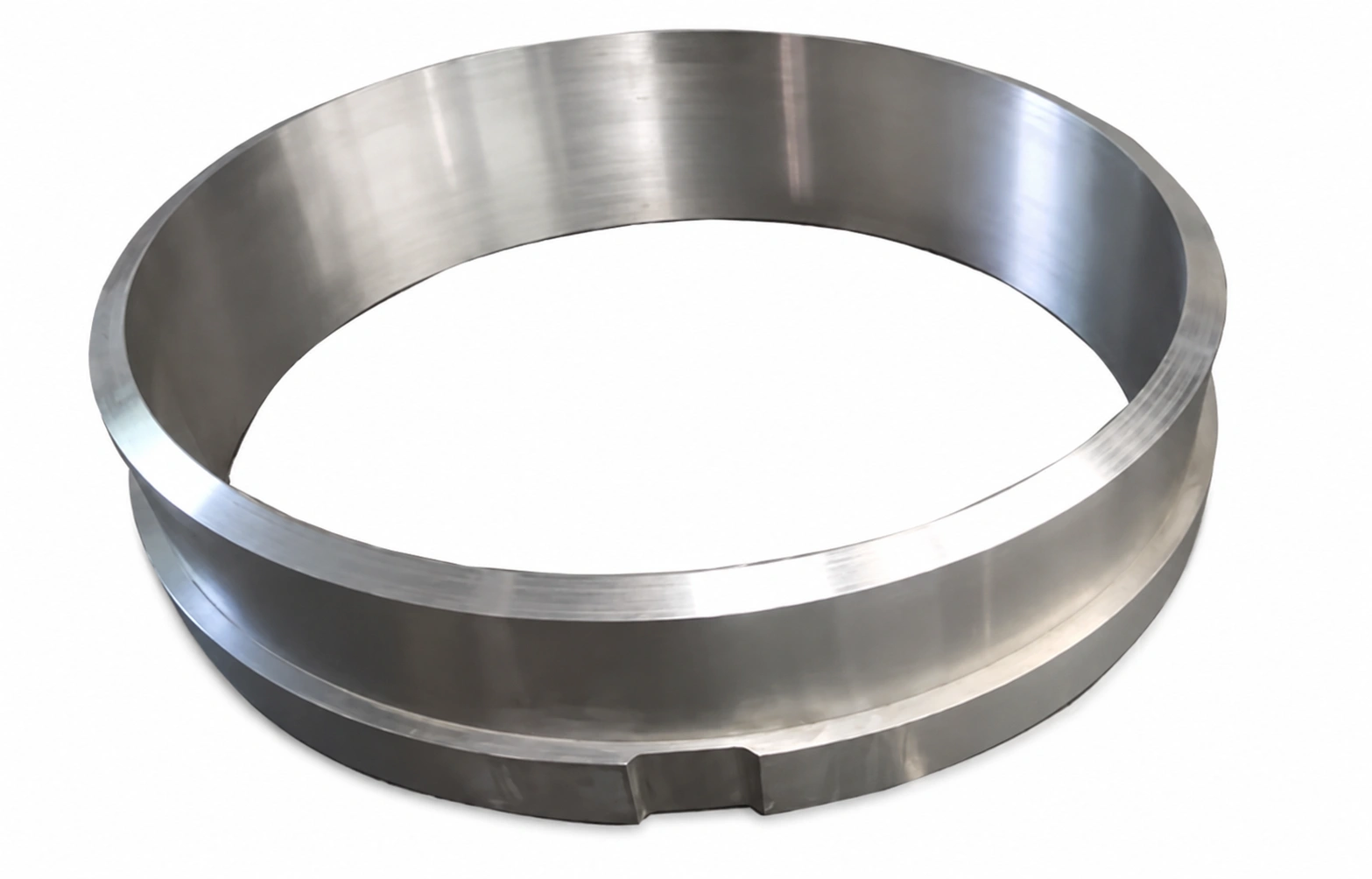
- Seamless Rolled Rings: Precision rings for Nuclear SMR cooling loops and marine flange assemblies up to 3,500mm.
- Open-Die Forging: Cost-effective for custom blocks, shafts, and large-scale marine hardware.
Key Applications for Forged 625
- Nuclear Energy: Primary reactor cooling loop components and SMR heat exchanger hardware.
- Marine & Subsea: Propeller blades, exhaust systems, and high-pressure subsea valve stems.
- Chemical Processing: Tubing, flare stacks, and reaction vessels handling highly corrosive acids.
- Aerospace: Engine exhaust systems and fuel line bellows.
Quality Assurance & NDT Suite
Every Inconel 625 forging is subjected to our proprietary Tier-1.5 Quality Protocol:
- Ultrasonic Testing (UT): 100% volumetric inspection to ensure zero internal inclusions.
- Dye Penetrant Inspection (LPI): Specialized for detecting surface-level porosity in corrosion-critical parts.
- Corrosion Testing: Intergranular corrosion testing (per ASTM G28) upon request to verify alloy purity.
- Full Traceability: MTR (Material Test Reports) from VIM/VAR melt sources.
FAQ: Sourcing Inconel 625 Forgings
Q: When should I choose 625 over 718 for a forging?
A: Choose Inconel 625 when your primary concern is corrosion or oxidation in harsh environments (like seawater or acids). Choose Inconel 718 when you need maximum mechanical strength and hardness for rotating parts like turbine disks.
Q: How does ForceBeyond manage the global supply of 625?
A: We maintain a strategic billet inventory across our US and Asian hubs. This “Tri-Regional” presence allows us to bypass mill backlogs and deliver forged 625 components in 12–16 weeks, compared to the industry average of 40+ weeks.
Request an Inconel 625 Technical Consultation
Typical response time: 48 hours for full technical and feasibility review.
Sources
- American Foundry Society. “Metal Casting”
- Wikipedia. “Investment Casting“, “Sand Casting“
- efunda. “Sand Casting“
- The Investment Casting Institute. “What is Investment Casting?“
- The Library of Manufacturing. “Investment Casting“
- Forging Industry Association “Forging Industry“
Our Internal Resources for Die Casting, Investment casting, Forging and Sand Casting
- Die Casting
- Aluminum Die Casting
- Zinc Die Casting
- A356 Aluminum Casting with T6 Heat Treatment
- Magnesium Die Casting
- Investment Casting
- Stainless Steel Casting
- Duplex Stainless Steel Casting
- Super Duplex Stainless Steel Casting
- Titanium Casting
- Carbon & Low Alloy Casting
- Forging
- Cold Forging
- Hot Forging
- ECO BRASS C69300 Brass Forging
- Sand Casting (Aluminum Sand Casting, Ductile Iron Sand Casting, Gray Iron Sand Casting)
- Specialty Fittings and Fasteners
- Precision CNC Machining and Secondary Operations