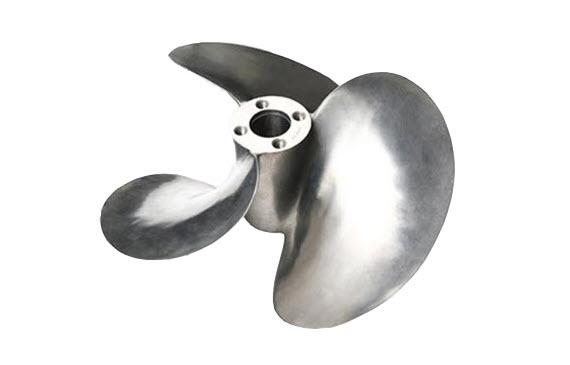
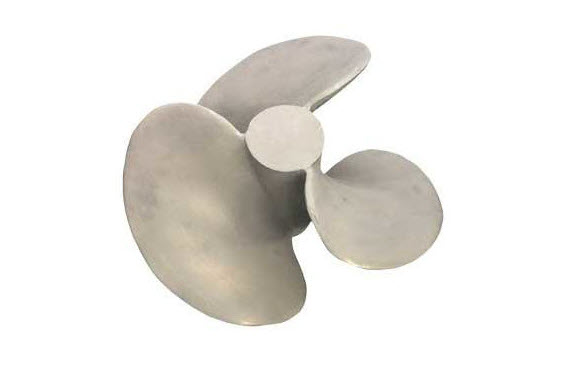
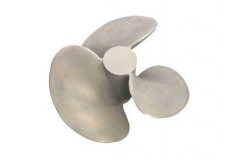
A titanium boat propeller is a marine propulsion component manufactured via precision titanium investment casting and CNC machining for high-performance naval defense vessels, marine engine propulsion, and offshore patrol craft requiring exceptional cavitation resistance, seawater corrosion immunity, and a high strength-to-weight ratio.
We maintain proactive communication with our customers to assure that we fully understand our customers’ requirements and produce parts with the desired characteristics in the most cost effective manner.
If you are looking for Titanium Boat Propeller, get in touch today and we will provide you with an accurate quote and our best services.
Watch the video of our titanium casting and titanium alloy facility to learn how titanium castings and titanium alloys & sheets are made. Video also available on
youtube.com
.
Marine Hydrodynamic Advantages of Titanium Boat Propellers
Marine propulsion systems operating in high-velocity littoral, offshore, and racing environments demand materials capable of enduring cyclic wave shock, intense hydrodynamic shear, and aggressive saltwater cavitation. Titanium boat propellers provide distinct mechanical and electrochemical advantages over traditional nickel-aluminum bronze (NAB), manganese bronze, and 316L stainless steel:
Superior Cavitation Erosion Resistance:
At high rotational speeds and blade loading, localized pressure drops trigger vapor bubble formation and violent collapse against the blade surface. Ti-6Al-4V Grade 5 exhibits an erosion incubation resistance more than 3.5× higher than nickel-aluminum bronze, preventing blade tip pitting, trailing edge thinning, and chord loss.
Total Seawater Corrosion Immunity:
Titanium forms a spontaneous, highly stable titanium dioxide (TiO2) passive film that remains completely impervious to seawater pitting, crevice attack, and microbiologically influenced corrosion (MIC) at ambient and elevated operating temperatures up to 600°F (316°C). It exhibits zero dezincification or de-aluminification degradation.
42% Rotational Inertia Reduction:
With a density of 0.160 lb/in³ (4.43 g/cm³) compared to 0.278 lb/in³ (7.70 g/cm³) for bronze and 0.290 lb/in³ (8.03 g/cm³) for stainless steel, titanium propellers dramatically reduce overhung mass and rotating moment of inertia. This delivers faster throttle response, lower torsional vibration spikes on drive shafts, and reduced bearing wear on marine gearboxes.
ForceBeyond manufactures marine titanium boat propellers utilizing vacuum skull melting investment casting followed by Hot Isostatic Pressing (HIP per AMS 4991). Ceramic shell molds backed with zirconia or yttria facecoats isolate the molten titanium from atmospheric oxygen, nitrogen, and carbon, preventing the formation of a brittle surface alpha-case layer during solidification.
Following HIP densification at 1,650°F (900°C) and 15 ksi (103 MPa) argon pressure, propeller blade foils undergo 5-axis continuous CNC contour milling to achieve precise progressive pitch distribution, custom rake angles, and hydrofoil camber profiles. Hub bores are precision-turned and broached with internal splines or standard 1:10 and 1:16 SAE marine shaft tapers to ensure concentric torque transmission without keyway fretting.
To suppress boundary layer separation and maximize marine propulsion efficiency, propeller suction and pressure faces receive precision hand-finishing and automated vibratory superfinishing down to 16 Ra (0.4 µm). For installations mounted on stainless steel prop shafts, ForceBeyond supplies engineered composite or non-conductive isolation sleeves and Delrin thrust washers to eliminate galvanic cell coupling between dissimilar marine metals.
Titanium Boat Propeller
Titanium Casting Titanium Boat Propeller
Titanium Casting Titanium Boat Propeller
Frequently Asked Questions
Why choose titanium for marine boat propellers?
Titanium Grade 5 (Ti-6Al-4V) provides complete immunity to seawater corrosion, superior cavitation resistance compared to bronze or stainless steel, and over 40% weight reduction, significantly increasing fuel efficiency and propulsion response.
How does ForceBeyond inspect and balance marine titanium propellers?
Propellers undergo multi-axis CNC pitch machining, dynamic balancing to ISO 1940 G2.5 tolerances, and 100% surface inspection per ASTM E1417 (FPI) to eliminate blade vibration and cavitation pitting.
What casting process is used for titanium propellers?
We utilize vacuum skull melting investment casting with ceramic shells, followed by Hot Isostatic Pressing (HIP per AMS 4991) to ensure full internal material density and structural integrity under heavy hydrodynamic loads.
Request a Quote for Titanium Boat Propellers
Tell us about your titanium alloy, propeller geometry, casting or machining requirements, inspection requirements, quantity, and delivery schedule.