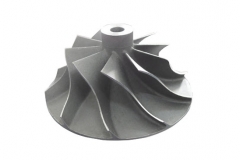
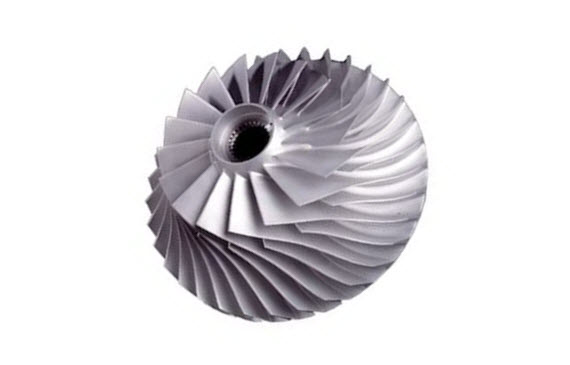
A titanium compressor impeller is a high-speed centrifugal compression component manufactured from forged or cast titanium alloys via 5-axis CNC machining for gas turbines, turbochargers, and aerospace environmental control systems.
We maintain proactive communication with our customers to assure that we fully understand our customers’ requirements and produce parts with the desired characteristics in the most cost effective manner.
If you are looking for Titanium Compressor Impeller, get in touch today and we will provide you with an accurate quote and our best services.
Watch the video of our titanium casting and titanium alloy facility to learn how titanium castings and titanium alloys & sheets are made. Video also available on
youtube.com
.
High-Speed Aerodynamic Advantages of Titanium Compressor Impellers
Centrifugal compressor stages in gas turbines, aerospace environmental control systems (ECS), automotive turbochargers, and industrial microturbines operate under extreme centrifugal force fields, transonic inducer Mach numbers, and high cyclic thermal fatigue. Titanium compressor impellers provide decisive engineering benefits over cast aluminum and steel impellers:
Transonic Tip Speed Capability (>550 m/s):
With an exceptional strength-to-density ratio, forged Ti-6Al-4V compressor impellers safely operate at peripheral tip speeds exceeding 1,800 ft/s (550 m/s), enabling pressure ratios greater than 4.5:1 in a single centrifugal compression stage without exceeding elastic stress limits.
Thermal Creep Strength up to 900°F (482°C):
While conventional 2000-series and 7000-series aerospace aluminum alloys experience severe mechanical property roll-off above 300°F (149°C), titanium alloys (such as Ti-6Al-4V and Ti-6-2-4-2) retain high yield strength, modulus of elasticity, and creep rupture resistance through full compressor discharge operating temperatures.
Aeroelastic Flutter & Blade Chatter Resistance:
Precision 5-axis continuous flank milling produces aerodynamically thin splitter blades with root fillets engineered to suppress aerodynamic flutter. Titanium's high natural frequency dampens resonant excitation harmonics, preventing high-cycle fatigue (HCF) failure across wide operating speed envelopes.
ForceBeyond produces titanium compressor impellers exclusively from vacuum-arc remelted (VAR) forged billets meeting AMS 4928 or AMS 4976 aerospace specifications. Machining is conducted on simultaneous 5-axis CNC machining centers equipped with high-pressure through-spindle coolant delivery (up to 1,000 psi) to evacuate chips rapidly and prevent localized work-hardening during thin-blade contouring.
Trailing edge thicknesses down to 0.020 in (0.50 mm) are achieved within ±0.0010 in (±0.025 mm) profile tolerances. Every compressor wheel undergoes spin-pit vacuum overspeed proof testing at 115% to 120% of maximum operating RPM per FAA / aerospace requirements, followed by two-plane electronic dynamic balancing to ISO 1940 G1.0 or G0.4 standards to eliminate high-speed vibration and shaft bearing loads.
Why are titanium alloys preferred over aluminum for compressor impellers?
Titanium Grade 5 (Ti-6Al-4V) maintains mechanical strength at elevated temperatures up to 750°F (400°C) and provides vastly superior fatigue resistance against high-cycle pressure pulses compared to aluminum alloys.
What manufacturing methods are used for titanium compressor impellers?
We produce impellers via simultaneous 5-axis CNC milling from forged billet (AMS 4928) or precision vacuum investment casting (AMS 4991), followed by dynamic balancing and coordinate measuring machine (CMM) inspection.
What surface finish can be achieved on thin impeller blades?
Aerodynamic blade profiles achieve surface roughness finishes of 32 to 63 Ra (μin) (0.8 to 1.6 μm Ra), optimized to minimize aerodynamic boundary-layer losses and maximize compression efficiency.
Request a Quote for Titanium Compressor Impellers
Tell us about your titanium alloy, compressor impeller geometry, casting or machining requirements, inspection requirements, quantity, and delivery schedule.