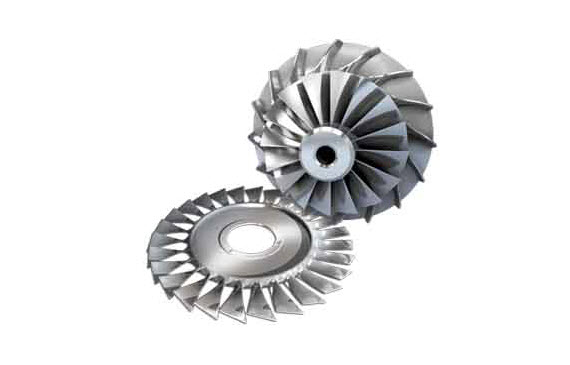
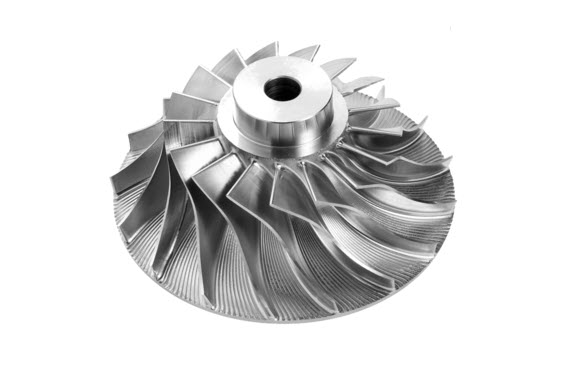
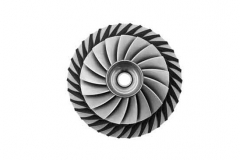
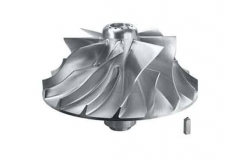
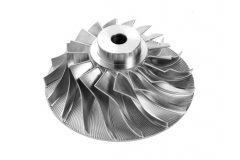
A titanium impeller is an engineered turbomachinery component manufactured via precision titanium casting and 5-axis CNC machining for high-stress aerospace, marine propulsion, and chemical processing environments.
We maintain proactive communication with our customers to assure that we fully understand our customers’ requirements and produce parts with the desired characteristics in the most cost effective manner.
If you are looking for titanium impeller, get in touch today and we will provide you with an accurate quote and our best services.
Watch the video of our titanium casting and titanium alloy facility to learn how titanium castings and titanium alloys & sheets are made. Video also available on
youtube.com
.
Industrial & Chemical Pumping Advantages of Titanium Impellers
In harsh chemical processing, mineral extraction, and marine desalination pumping systems, impellers face simultaneous hydraulic erosion, fluid turbulence, and severe chemical corrosion. Monolithic titanium impellers provide essential operating advantages over super duplex stainless steels (such as 2507) and nickel alloys:
Total Passivity in Oxidizing Acids & Chlorides:
Titanium forms an impermeable TiO2 dielectric oxide barrier that resists attack in boiling nitric acid, wet chlorine gas, chlorate solutions, chlorine dioxide, and high-temperature ferric chloride solutions where austenitic and duplex steels suffer rapid crevice corrosion and stress corrosion cracking (SCC).
Net Positive Suction Head (NPSHr) Optimization:
Precision investment cast and 5-axis milled blade inlet geometries allow thinner, hydrodynamically curved vane tips. This reduces entry flow blockage, minimizes suction eye fluid shock, and lowers the required NPSH to suppress acoustic cavitation at high suction velocities.
Monolithic Shroud Integrity:
Unlike welded impellers susceptible to heat-affected zone (HAZ) sensitization and weld-root crevice corrosion, ForceBeyond manufactures enclosed impellers via monolithic ceramic-core investment casting or 5-axis billet machining, ensuring continuous uniform grain structure from hub to shroud.
Industrial titanium impellers are produced via vacuum investment casting using soluble ceramic cores that define intricate internal fluid flow passages between front and rear shrouds. Following casting in high-vacuum induction skull furnaces (VIM), impellers undergo Hot Isostatic Pressing (HIP per ASTM B367) to eliminate all internal gas porosity and micro-shrinkage.
Critical hydraulic features—including vane discharge angles, wear ring sealing diameters, and rear shroud hydraulic balance holes—are finish-machined on multi-axis CNC turn-mill centers. Balance holes are calibrated to equalize axial pressure differentials across the impeller, relieving thrust bearing loads and extending mechanical seal life in accordance with API 610 and ISO 5199 pump standards.
Chemical Passivation & Surface Treatment Protocols
After mechanical machining and balancing, all titanium impellers undergo chemical pickling and passivation per ASTM A967 and AMS 2700. This nitric-hydrofluoric acid treatment dissolves any iron contamination deposited by cutting tools and thickens the native TiO2 barrier layer. When required for abrasive slurry service, thermal oxidation or physical vapor deposition (PVD) titanium nitride (TiN) hard coatings are applied to increase surface hardness above 80 HRC.
What titanium alloy is recommended for high-speed impellers?
Ti-6Al-4V (Grade 5 / AMS 4928) is the industry benchmark for high-speed impellers due to its exceptional strength-to-weight ratio, fatigue endurance, and corrosion resistance in marine and chemical environments.
How does ForceBeyond ensure balance and dimensional accuracy on titanium impellers?
Impellers are 5-axis CNC machined to tolerances within ±0.001 in (±0.025 mm) and dynamically balanced to ISO 1940 G2.5 specifications to ensure smooth operation at high rotational speeds.
What non-destructive testing (NDT) is performed on titanium impellers?
Depending on application criticality, we perform 100% Fluorescent Penetrant Inspection (FPI per ASTM E1417) for surface integrity and Radiographic Examination (X-ray per ASTM E1742) for cast internal soundness.
Request a Quote for Titanium Impellers
Tell us about your titanium alloy, impeller geometry, casting or 5-axis machining requirements, inspection requirements, quantity, and delivery schedule.