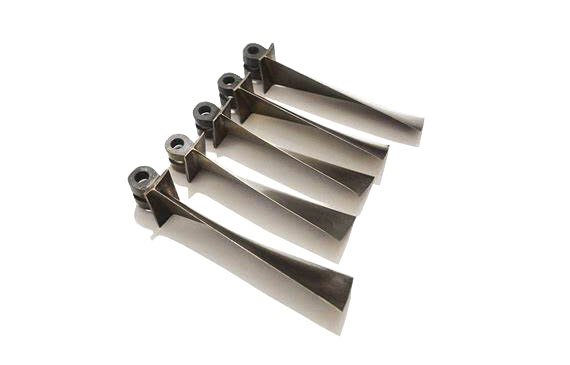
A titanium jet engine blade is an aerospace airfoil component manufactured via precision titanium forging or vacuum investment casting with 5-axis CNC machining for modern turbofan and turbojet compressor stages.
We maintain proactive communication with our customers to assure that we fully understand our customers’ requirements and produce parts with the desired characteristics in the most cost effective manner.
If you are looking for titanium jet engine blade, get in touch today and we will provide you with an accurate quote and our best services.
Watch the video of our titanium casting and titanium alloy facility to learn how titanium castings and titanium alloys & sheets are made. Video also available on
youtube.com
.
Advantage of Titanium Jet Engine Blades
Strength and lightweight:
As strong as most common steels with less than 40% of the counterpart’s weight.
Corrosion resistance:
Almost as resistant to chemical attack as platinum. One of best candidates for seawater and chemical handling components.
Cosmetic appeal:
Titanium cosmetic and technical appeal even outperforms the precious metals especially in the consumer marketplace.
Titanium Alloys Information for Titanium Jet Engine Blades
Titanium offers a high strength to weight ratio and extraordinary corrosion resistance, making it an ideal choice for medical, marine, hand tools, sporting goods, and high performance automotive applications. We supply all grades of titanium alloys: Alpha alloys, Near Alpha alloys, Alpha and Beta alloys, Beta alloys. For oil and gas industry we supply high strength titanium alloys Titanium 6-2-4-6; for casting industry, we supply Grade 5 titanium and CP titanium.
There are two common casting titanium alloys: Titanium Grade 2 and Titanium Grade 5. Please see below for detailed characteristics, applications etc.
Titanium Alloy Grade 2
Titanium Grade 2 is light weight and highly corrosion resistant. It is an unalloyed titanium and is considered a “commercially pure” titanium (TiCP). Thanks to its varied usability and wide availability, Grade 2 is used in most of the chemical processing plants and is cold formable. Grade 2 plate and sheet can have ultimate tensile strength at and above 40,000 psi.
With moderate strength and excellent corrosion resistance, it also offers ductility and high impact toughness, and good weldability. It is used commonly in applications that require welding. Grades 2 is not hardenable by heat treatment.
Applications for Titanium Casting & Machining Alloy Grade 2
Chemical Processes
Grade 2 titanium is highly resistant to chemical environments including oxidising, alkaline, organic acids and compounds, aqueous salt solutions and hot gases. Its corrosion resistance holds up in, nitric acid, mildly reducing acids and wet chlorine or bromine gas.
Marine
In seawater, Grade 2 is resistant to corrosion at temperatures up to 315°C, rendering it ideal for a variety of marine uses.
Titanium Alloy Grade 5
Titanium Grade 5 is the most commonly used Titanium worldwide. Titanium Grade 5 is alloyed with 6% Aluminum and 4% Vanadium and is commonly known as Ti 6Al-4V. Grade 5 or Ti 6Al-4V, accounts for 50 percent of total titanium usage the world over.
It can be heat treated to enhance mechanical properties. It can be used in welded fabrication at service temperatures of up to 315°C. This alloy offers high strength at a light weight, useful formability and high corrosion resistance.
Applications for Titanium Casting & Machining Alloy Grade 5
Industries
Aerospace, medical, marine and chemical processing industries and oil field services.
Plate
The material is worked to the closest size of the desired part and the grain structure of the finished piece is more homogenous.
Heat Barrier
Titanium stops the heat and does not transfer to the rest of the assembly.
Engineering Specifications & Quality Standards
Titanium Jet Engine Blade Material & Manufacturing Specifications
Parameter
Ti-6Al-4V Grade 5 (UNS R56400) / Ti-6242
Standard / Test Method
Tensile Strength (UTS)
135 – 150 ksi (930 – 1034 MPa)
ASTM E8 / AMS 4928
Yield Strength (0.2% Offset)
125 – 140 ksi (860 – 965 MPa)
ASTM E8 / AMS 4928
Aerospace Material Specification
AMS 4928 (Forged) / AMS 4991 (Cast)
SAE International / ASTM B348
Root Dovetail & Airfoil Profile
±0.0008 in (±0.020 mm) CMM Verified
AS9100D / ISO 9001:2015
NDT & Ultrasonic Integrity
100% FPI Level 4 & Ultrasonic Inspection
ASTM E1417 / AMS 2631
Surface Treatment for Titanium Jet Engine Blades
Surface Treatment for Casting & Machining Titanium Alloys
Corrosion Resistance and Surface Treatment
1) The atmospheric oxidation treatment
2) Precious metal coating
3) Dry coating TiC, TiA membrane (CVD, w2, PCVD)
4) Pb + Pt + injection (ion beam and electron beam)
1) Surface finish
2) The mirror finishing
3) Color
Titanium Jet Engine Blades
Titanium Jet Engine Blade Turbine Aircraft
Frequently Asked Questions
What titanium alloys are used for jet engine compressor blades?
Ti-6Al-4V (AMS 4928 / Grade 5) is standard for intermediate compressor stages, while Ti-6Al-2Sn-4Zr-2Mo (Ti-6242) is used for higher temperature high-pressure compressor (HPC) stages operating up to 850°F (454°C).
How are titanium jet engine blades manufactured and inspected?
Blades are produced through closed-die isothermal forging or precision vacuum casting, followed by 5-axis CNC airfoil milling, root broaching, and 100% fluorescent penetrant inspection per ASTM E1417.
Can ForceBeyond support AS9100 Rev D aerospace quality requirements?
Yes. Our aerospace manufacturing network operates under AS9100 Rev D and ISO 9001:2015 quality standards with full material test report (MTR) traceability and AS9102 First Article Inspection (FAI) reports.
Request a Quote for Titanium Jet Engine Blades
Tell us about your titanium alloy, blade geometry, machining, inspection, quantity, and delivery requirements and our team will review your project.