
Inconel 718 Machining Services: Precision 5-Axis CNC & Turning
High-tolerance CNC milling, turning, and EDM for Inconel 718 (UNS N07718). ForceBeyond provides AS9100-certified machining solutions utilizing rigid workholding, high-pressure coolant, and advanced ceramic tooling across our co-owned USA, South Korea, and Taiwan facilities.
As a dedicated capability within our Superalloy Machining Services, ForceBeyond specializes in the precision material removal of Inconel 718. As a Tier-1.5 manufacturing partner, we seamlessly integrate our machining centers with our Inconel 718 Forging and Inconel 718 Casting operations. This single-source approach—managed by our Delaware engineering team and executed across our co-owned facilities in the USA, South Korea, and Taiwan—eliminates the extreme risks of third-party machining. Specifically, we mitigate work-hardening, tool deflection, and dimensional distortion by controlling the metallurgical state of the part from the initial pour or strike through to the final 5-axis CNC finish, ensuring your aerospace and power-generation components meet exact print specifications.”
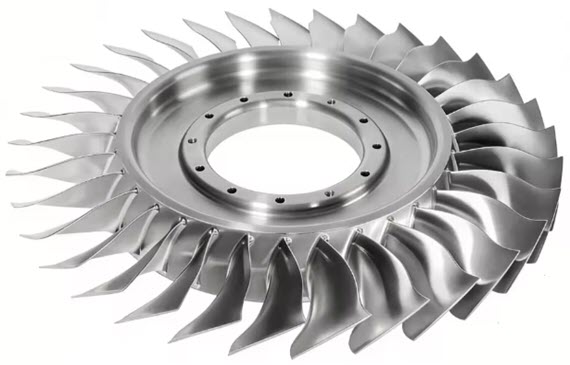
The Metallurgical Challenge of Machining 718
Inconel 718 retains its ultra-high yield strength (1,035 MPa) at extreme temperatures. This creates three primary challenges during CNC machining that standard machine shops cannot overcome:
- Low Thermal Conductivity: Heat does not dissipate into the chip; it concentrates at the cutting edge, leading to rapid tool deformation.
- Severe Work-Hardening: Abrasive carbides in the alloy’s microstructure cause the machined surface to harden instantly during the cut, destroying subsequent tooling.
- High Shear Strength: Requires immense spindle torque and absolute machine rigidity to prevent chatter and geometric failure.
ForceBeyond’s Inconel 718 Machining Parameters
To achieve tight tolerances (± 0.005mm) and superior surface finishes (Ra 0.8), our facilities utilize strictly controlled machining parameters developed specifically for nickel-chromium matrices.
Table: Typical CNC Machining Parameters for Inconel 718
| Machining Operation | Tooling Material | Cutting Speed (SFM) | Feed Rate (IPR/IPT) |
|---|---|---|---|
| Rough Turning | SiAlON Ceramic | 600 – 800 SFM | 0.008 – 0.012 IPR |
| Heavy-Duty CNC Turning | Forged turbine disks, engine shafts, and seamless rings. | High-torque spindles designed for the massive shear forces of nickel superalloys. | |
| Finish Turning | PVD Coated Carbide | 100 – 150 SFM | 0.004 – 0.006 IPR |
| Rough Milling | Whisker-Reinforced Ceramic | 700 – 1,000 SFM | 0.003 – 0.005 IPT |
| Finish Milling | Solid Carbide (TiAlN Coat) | 80 – 120 SFM | 0.002 – 0.004 IPT |
Machining States: Annealed vs. Age-Hardened
ForceBeyond optimizes the production routing based on your component’s geometric complexity and required mechanical properties.
- Solution Annealed State (AMS 5662): Ideal for heavy material removal (roughing). The alloy is softer (approx. 20-25 HRC), allowing for faster cycle times and extended tool life.
- Age-Hardened State (AMS 5663): For ultimate precision, we perform finish machining after precipitation hardening (approx. 36-44 HRC). This eliminates the risk of dimensional distortion that occurs during the heat-treatment furnace cycle.
Quality Assurance & Inspection Protocols
NDT & Dimensional Verification
| Inspection Method | Superalloy Application | Standard Compliance |
|---|---|---|
| CMM Inspection | 100% dimensional verification of 5-axis geometries. | ± 0.005mm accuracy |
| Fluorescent Penetrant (FPI) | Surface-breaking crack detection post-machining. | ASTM E1417 / Nadcap |
| Ultrasonic Testing (UT) | Internal inclusion/void detection in forged blanks. | AMS 2154 |
| Hardness Testing | Confirming precipitation hardening (AMS 5663). | 36 – 44 HRC |
Frequently Asked Questions: Machining Inconel 718
Q: Can you machine Inconel 718 in the fully aged condition (AMS 5663)?
A: Yes. While it is highly abrasive at 36–44 HRC, finish-machining in the age-hardened condition is the only way to guarantee tight aerospace tolerances without risking geometric distortion from subsequent heat treatment. We use advanced PVD-coated solid carbide tooling to achieve precision finishes on hardened 718.
Q: How do you prevent work-hardening when milling Inconel 718?
A: Work-hardening occurs when a tool rubs against the material instead of shearing it. We prevent this by utilizing strict climb-milling (thick-to-thin) toolpaths, maintaining continuous feed rates, and never allowing the tool to dwell in the cut.
Q: Why use ceramic tooling for roughing Inconel 718?
A: Ceramic inserts (like SiAlON and whisker-reinforced ceramics) retain their hardness at much higher temperatures than carbide. This allows us to push cutting speeds up to 1,000 SFM during roughing operations, significantly reducing cycle times and driving down the cost for our customers.
Q: Do you machine superalloys other than Inconel 718 and 625?
A: Yes. While our primary high-volume production is centered on Inconel 718 and Inconel 625, our high-torque CNC turning and 5-axis milling centers are fully equipped to machine Waspaloy, Hastelloy (C-276, X), and Cobalt-based superalloys for specialized medical and power generation applications.
In the aerospace and defense sectors, verification is as critical as the machining itself. All ForceBeyond facilities operate under a unified AS9100 Rev D quality framework, providing full Heat Lot Traceability.
Request an Inconel 718 Machining Quote
Ready to eliminate your supply chain bottlenecks? As your Tier-1.5 manufacturing partner, ForceBeyond delivers fully machined, print-ready Inconel 718 components with uncompromising AS9100-certified quality.
Our Delaware-based engineering team is ready to review your project. We provide comprehensive Design for Manufacturability (DFM) feedback, cycle-time estimates, and globally optimized pricing from our USA, South Korea, and Taiwan facilities.
What to include in your RFQ:
To ensure the fastest and most accurate turnaround, please provide:
- 3D CAD Models (STEP, IGES, or SolidWorks formats)
- 2D Print Drawings (PDF with all GD&T and critical tolerances)
- Material Specifications (e.g., Inconel 718 to AMS 5662 or 5663)
- Estimated Annual Usage (EAU) or specific lot sizes
Typical engineering review and response time: 24 to 48 hours.
Sources
- American Foundry Society. “Metal Casting”
- Wikipedia. “Investment Casting“, “Sand Casting“
- efunda. “Sand Casting“
- The Investment Casting Institute. “What is Investment Casting?“
- The Library of Manufacturing. “Investment Casting“
- Forging Industry Association “Forging Industry“
Our Internal Resources for Die Casting, Investment casting, Forging and Sand Casting
- Die Casting
- Aluminum Die Casting
- Zinc Die Casting
- A356 Aluminum Casting with T6 Heat Treatment
- Magnesium Die Casting
- Investment Casting
- Stainless Steel Casting
- Duplex Stainless Steel Casting
- Super Duplex Stainless Steel Casting
- Titanium Casting
- Carbon & Low Alloy Casting
- Forging
- Cold Forging
- Hot Forging
- ECO BRASS C69300 Brass Forging
- Sand Casting (Aluminum Sand Casting, Ductile Iron Sand Casting, Gray Iron Sand Casting)
- Specialty Fittings and Fasteners
- Precision CNC Machining and Secondary Operations
Sources
- American Foundry Society. “Metal Casting”
- Wikipedia. “Investment Casting“, “Sand Casting“
- efunda. “Sand Casting“
- The Investment Casting Institute. “What is Investment Casting?“
- The Library of Manufacturing. “Investment Casting“
- Forging Industry Association “Forging Industry“
Our Internal Resources for Die Casting, Investment casting, Forging and Sand Casting
- Die Casting
- Aluminum Die Casting
- Zinc Die Casting
- A356 Aluminum Casting with T6 Heat Treatment
- Magnesium Die Casting
- Investment Casting
- Stainless Steel Casting
- Duplex Stainless Steel Casting
- Super Duplex Stainless Steel Casting
- Titanium Casting
- Carbon & Low Alloy Casting
- Forging
- Cold Forging
- Hot Forging
- ECO BRASS C69300 Brass Forging
- Sand Casting (Aluminum Sand Casting, Ductile Iron Sand Casting, Gray Iron Sand Casting)
- Specialty Fittings and Fasteners
- Precision CNC Machining and Secondary Operations