
Industrial Titanium Sand Casting: Large-Scale Corrosion Resistant Solutions
ForceBeyond provides high-capacity Industrial Titanium Sand Casting for large-scale, corrosion-critical components. Specializing in ASTM B367 grades, our co-owned facilities produce heavy-walled castings for pump housings, valve bodies, and heat exchanger components. By utilizing advanced vacuum-rammed graphite and sand molding techniques, we deliver titanium components up to 60 inches (1,500mm) in diameter, offering the ultimate protection for aggressive chemical and marine environments.
Engineering for Scale: The Sand Casting Process
While investment casting is limited by wax tree sizes, our sand casting process is designed for the “Heavyweights” of the industrial sector. We utilize specialized molding media to minimize the “Alpha-Case” reaction typically associated with large titanium pours.
- Vacuum-Rammed Molding: High-purity graphite or specialized sand is vacuum-packed to ensure mold stability during high-volume titanium pours.
- Large-Envelope Melting: Our VIM (Vacuum Induction Melting) furnaces are configured for large-batch pours, ensuring chemical homogeneity across heavy sections.
- Complex Coring: We utilize robust internal cores to create intricate flow paths for pump impellers and multi-port valve bodies that would be impossible to forge.
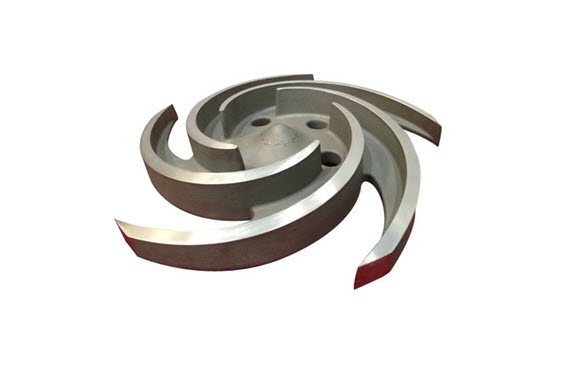
Technical Benchmarks: Sand Casting vs. Investment Casting
| Feature | Industrial Sand Casting | Precision Investment Casting |
|---|---|---|
| Maximum Part Size | Up to 60″ (1,500mm) | Up to 24″ (600mm) |
| Typical Wall Thickness | 0.180″ – 3.00″+ | 0.060″ – 0.500″ |
| Geometric Complexity | Moderate to High | Extreme |
| Surface Finish | 250–500 RMS | 63–125 RMS |
| Ideal Application | Pump/Valve Bodies | Turbine Blades/Implants |
Multi-Process Optimization: The Tier-1.5 Advantage
ForceBeyond’s integrated network ensures that even the largest castings meet the precision requirements of modern industrial systems.
Heavy Finishing: Industrial Titanium Machining
Large sand castings require significant “roughing” to reach final tolerances. Our co-owned machining centers are equipped with high-torque, large-envelope CNC mills specifically calibrated for the scale of sand-cast components.
High-Integrity Upgrade: Titanium Aerospace Casting
If your industrial project requires the surface finish or thin-wall capabilities of aerospace hardware, we can pivot your design to our Titanium Investment Casting for a higher-precision near-net-shape solution.
Materials & Corrosion Standards
We cast a wide range of titanium alloys designed to withstand the world’s most aggressive environments, from desalination plants to offshore oil platforms.
- CP Grade 2 (ASTM B367 Grade C-2): The workhorse of the chemical industry; offers excellent weldability and corrosion resistance.
- Ti-6Al-4V (ASTM B367 Grade C-5): For high-strength structural industrial components.
- Ti-Pd Grade 7 (ASTM B367 Grade C-7): Palladium-stabilized for extreme resistance to crevice corrosion in acidic media.
FAQ: Industrial Titanium Sand Casting
Q: What is the lead time for large sand-cast components?
A: Due to the complexity of large-scale mold preparation and vacuum melting, lead times typically range from 14 to 18 weeks, including pattern making and NDT verification.
Q: Do large sand castings require HIP (Hot Isostatic Pressing)?
A: While HIP is always recommended for maximum integrity, many industrial pump and valve applications can meet performance specs without it, provided they pass 100% Radiographic (X-Ray) inspection.
Q: Can you handle the pattern equipment for legacy parts?
A: Yes. We can work from existing wood or plastic patterns, or our engineering team can reverse-engineer your legacy part using 3D scanning to create new high-durability pattern equipment.
Request an Industrial Casting Quote
Scale Your Production with Proven Corrosion-Resistant Technology.
Please provide the following for a technical quote:
- Dimensional Drawings: (Including flange specs and wall thickness requirements)
- Chemical Environment: (To help us recommend the optimal Titanium Grade)
- Testing Requirements: (e.g., Hydrostatic pressure testing, X-Ray, or Dye Penetrant)
- Estimated Annual Usage (EAU): To optimize pattern costs and material purchasing.
Sources
- American Foundry Society. “Metal Casting”
- Wikipedia. “Investment Casting“, “Sand Casting“
- efunda. “Sand Casting“
- The Investment Casting Institute. “What is Investment Casting?“
- The Library of Manufacturing. “Investment Casting“
- Forging Industry Association “Forging Industry“
Our Internal Resources for Die Casting, Investment casting, Forging and Sand Casting
- Die Casting
- Aluminum Die Casting
- Zinc Die Casting
- A356 Aluminum Casting with T6 Heat Treatment
- Magnesium Die Casting
- Investment Casting
- Stainless Steel Casting
- Duplex Stainless Steel Casting
- Super Duplex Stainless Steel Casting
- Titanium Casting
- Carbon & Low Alloy Casting
- Forging
- Cold Forging
- Hot Forging
- ECO BRASS C69300 Brass Forging
- Sand Casting (Aluminum Sand Casting, Ductile Iron Sand Casting, Gray Iron Sand Casting)
- Specialty Fittings and Fasteners
- Precision CNC Machining and Secondary Operations