
Titanium Aerospace Casting: AS9100-Certified Flight-Critical Components
ForceBeyond provides high-integrity Titanium Aerospace Casting for propulsion, structural airframes, and high-pressure fluid systems. Utilizing Vacuum Induction Melting (VIM) and Hot Isostatic Pressing (HIP), we deliver cast components that meet the rigorous AMS 4991 and ASTM B367 standards. Our Tier-1.5 integrated model allows for the production of complex, thin-walled geometries that reduce assembly weight while maintaining the structural reliability required for modern aerospace platforms.
Aerospace Application Specialization
We specialize in components where geometric complexity makes forging or machining from solid billet cost-prohibitive. Our co-owned AS9100 facilities ensure total traceability for every flight-critical part.
- Engine & Propulsion: Fan frames, compressor housings, Titanium Turbine Blades, and exhaust nozzles.
- Environmental Control Systems (ECS): Complex valve bodies, bleed-air ducting, and manifold assemblies.
- Structural Components: Wing-tip ribs, door frames, and nacelle hardware.
- Fuel & Hydraulic Systems: High-pressure pump housings and fuel control bodies.
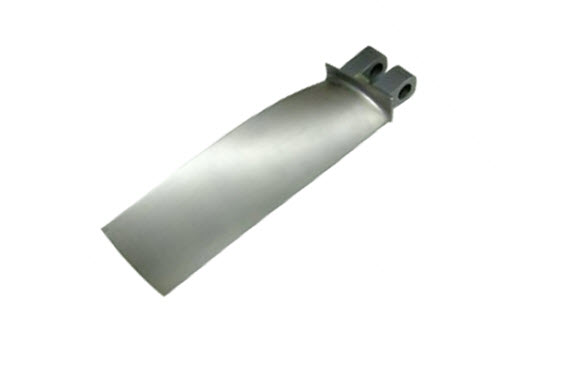
Engineering Excellence: The VIM + HIP Protocol
ForceBeyond utilizes a specific metallurgical protocol to guarantee that cast components achieve the isotropic strength and internal soundness required for aerospace service.
Vacuum Induction Melting (VIM)
Titanium’s extreme affinity for oxygen requires a total vacuum environment during the melt. Our VIM process ensures zero “Alpha-Case” contamination, preserving the material’s ductility and fatigue resistance throughout the solidification phase.
Hot Isostatic Pressing (HIP)
Mandatory for all flight-critical hardware, HIP processing subjects castings to simultaneous high temperature and inert gas pressure. This collapses internal micro-shrinkage and gas porosity, transforming the as-cast structure into a fully dense material with mechanical properties approaching wrought levels.
Aerospace Casting Standards & Inspection
Our Tier-1.5 oversight ensures that every component passes the most stringent nondestructive testing (NDT) protocols required by global aerospace primes and defense contractors.
| Standard | Description | Application |
|---|---|---|
| AMS 4991 | Titanium Alloy Castings (6Al-4V) | Primary aerospace investment casting spec. |
| ASTM B367 | Titanium & Titanium Alloy Castings | General engineering and industrial aerospace. |
| AMS 2175 | Classification of Castings | Standard for radiographic and visual inspection levels. |
Rigorous Quality Verification
- Radiographic Inspection (X-Ray): 100% verification of internal soundness to Grade A standards.
- Fluorescent Penetrant Inspection (FPI): Detection of surface-level discontinuities post-machining.
- Mechanical Testing: Destructive and non-destructive testing of accompanying test coupons from the same melt lot.
Multi-Process Optimization: Integrated Solutions
ForceBeyond provides the technical flexibility to pivot between manufacturing methods based on your project’s lifecycle and structural requirements.
Finish Precision: Aerospace Titanium Machining
All aerospace castings are finished in our co-owned CNC centers to achieve the plus or minus 0.005mm tolerances required for mating surfaces. This integrated “Cast-to-Finish” approach reduces supply chain risk.
High-Load Alternative: Titanium Aerospace Forging
For structural parts experiencing extreme unidirectional stress (like wing spars), our Titanium Forging Hub provides the directional grain flow required for maximum fatigue life.
FAQ: Titanium Aerospace Casting
Q: Can cast titanium be used for rotating engine parts?
A: Yes. When produced via VIM and treated with HIP, cast titanium turbine blades and fan components meet the fatigue requirements for many non-primary rotating applications, offering a significant weight and cost advantage over forged parts.
Q: What is the thinnest wall section you can achieve?
A: Through our specialized investment casting process, we can achieve wall thicknesses as low as 0.060 inches (1.5mm), depending on the overall part geometry and alloy.
Request an Aerospace Casting Quote
Streamline Your Aerospace Supply Chain with Direct Tier-1.5 Oversight.
Please provide the following for our engineering review:
- Technical Drawings: (Include NDT requirements and critical dimensions)
- Material Specification: (e.g., AMS 4991, Ti-6Al-4V)
- Quality Requirements: (Specify X-Ray and FPI inspection levels)
- Estimated Annual Usage (EAU): To assist in production planning and tooling optimization.
Sources
- American Foundry Society. “Metal Casting”
- Wikipedia. “Investment Casting“, “Sand Casting“
- efunda. “Sand Casting“
- The Investment Casting Institute. “What is Investment Casting?“
- The Library of Manufacturing. “Investment Casting“
- Forging Industry Association “Forging Industry“
Our Internal Resources for Die Casting, Investment casting, Forging and Sand Casting
- Die Casting
- Aluminum Die Casting
- Zinc Die Casting
- A356 Aluminum Casting with T6 Heat Treatment
- Magnesium Die Casting
- Investment Casting
- Stainless Steel Casting
- Duplex Stainless Steel Casting
- Super Duplex Stainless Steel Casting
- Titanium Casting
- Carbon & Low Alloy Casting
- Forging
- Cold Forging
- Hot Forging
- ECO BRASS C69300 Brass Forging
- Sand Casting (Aluminum Sand Casting, Ductile Iron Sand Casting, Gray Iron Sand Casting)
- Specialty Fittings and Fasteners
- Precision CNC Machining and Secondary Operations