
Titanium Investment Casting: High-Precision Lost Wax Solutions
ForceBeyond specializes in high-precision Titanium Investment Casting (Lost Wax), delivering complex, near-net-shape components with superior surface finishes. Utilizing Vacuum Induction Melting (VIM) at our AS9100-certified facilities, we produce intricate geometries with wall thicknesses as low as 0.060 inches (1.5mm). Our integrated Tier-1.5 oversight ensures that every investment cast part reaches ±0.005 inches per inch tolerances, minimizing the need for costly secondary machining.
The Investment Casting Process: Precision via Lost Wax
Our investment casting process is engineered for components that require high dimensional accuracy and complex internal features that cannot be achieved through traditional forging or sand casting.
- Pattern Creation: High-precision wax patterns are injected into custom-engineered steel dies.
- Ceramic Shell Building: Multiple layers of refractory ceramic create a robust mold capable of withstanding the reactivity of molten titanium.
- Vacuum Pouring: Molten titanium is poured in a total vacuum to ensure an oxide-free, high-purity metallurgical structure.
- Precision Decoring: Advanced chemical and mechanical cleaning removes all ceramic traces, even from complex internal cooling channels.
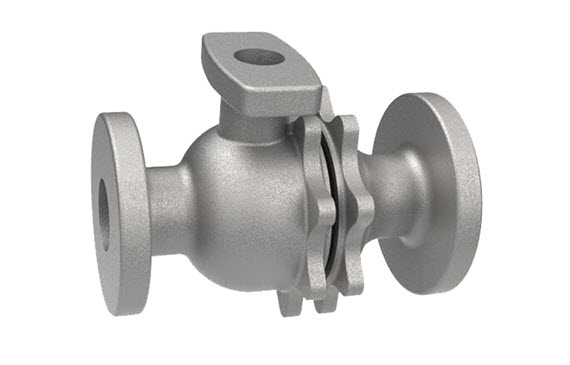
Technical Advantages for High-Complexity Designs
Engineers select the investment (lost wax) process when the requirement for geometric complexity exceeds the capabilities of traditional forging or sand casting. ForceBeyond utilizes specific performance metrics to justify process selection for high-performance assemblies:
| Feature | ForceBeyond Investment Casting | Industry Standard Sand Casting |
|---|---|---|
| Surface Finish | 63–125 RMS (Superior) | 250–500 RMS (Rough) |
| Linear Tolerance | ±0.005 in/in | ±0.030 in/in |
| Wall Thickness | Down to 0.060 in (1.5mm) | Min 0.180 in (4.5mm) |
| Feature Detail | Sharp Edges & Fine Text | Rounded Edges |
| Initial Tooling | Low to Moderate | Moderate |
Multi-Process Optimization: The Tier-1.5 Advantage
ForceBeyond ensures that your component is produced using the most efficient technology for its current design stage and volume requirements.
Integrated Finishing: Precision Titanium Machining
While investment casting produces near-net shapes, critical mating surfaces and threaded features require high-precision finishing. Our co-owned CNC centers specialize in machining investment-cast titanium without inducing surface stress.
Large-Scale Alternative: Industrial Titanium Sand Casting
For oversized components (exceeding 24 inches) used in the Power Generation or Chemical Processing industries, our sand casting spoke provides a cost-effective solution for heavy-walled pump and valve housings.
Quality Assurance & Metallurgical Integrity
Every investment casting produced in our network undergoes rigorous verification to ensure it meets the highest industrial and medical standards.
- In-House HIP Processing: Every part can be treated with Hot Isostatic Pressing to ensure 100% internal density and isotropic strength.
- Fluorescent Penetrant Inspection (FPI): Standard for all precision castings to verify surface integrity and fatigue resistance.
- Dimensional Verification: 100% CMM inspection for critical-to-quality (CTQ) dimensions.
FAQ: Titanium Investment Casting
Q: What is the maximum part size for investment casting?
A: Our standard investment casting envelope accommodates parts up to 24 x 24 x 24 inches. For larger components, we typically recommend our sand casting process.
Q: Can you cast internal threads?
A: While very coarse threads can sometimes be cast, we recommend casting the “tap hole” to a near-net size and performing final threading in our Titanium Machining centers to ensure class-3 fit tolerances.
Q: Is investment casting suitable for medical implants?
A: Yes. Using Ti-6Al-4V ELI (Grade 23) and vacuum induction melting, we produce biocompatible orthopedic and trauma components that meet stringent medical-grade requirements.
Request a Precision Casting Quote
Reduce Your Component Weight and Assembly Complexity.
Reduce Your Component Weight and Assembly Complexity.
Please provide the following for a technical evaluation:
- 3D CAD Files: (STEP or IGES format is preferred)
- Alloy Requirement: (e.g., Grade 2, Grade 5, or Grade 23 ELI)
- Surface Finish Specs: (Specify if any areas require post-cast polishing)
- Estimated Annual Usage (EAU): To assist in die life and unit cost optimization.
Sources
- American Foundry Society. “Metal Casting”
- Wikipedia. “Investment Casting“, “Sand Casting“
- efunda. “Sand Casting“
- The Investment Casting Institute. “What is Investment Casting?“
- The Library of Manufacturing. “Investment Casting“
- Forging Industry Association “Forging Industry“
Our Internal Resources for Die Casting, Investment casting, Forging and Sand Casting
- Die Casting
- Aluminum Die Casting
- Zinc Die Casting
- A356 Aluminum Casting with T6 Heat Treatment
- Magnesium Die Casting
- Investment Casting
- Stainless Steel Casting
- Duplex Stainless Steel Casting
- Super Duplex Stainless Steel Casting
- Titanium Casting
- Carbon & Low Alloy Casting
- Forging
- Cold Forging
- Hot Forging
- ECO BRASS C69300 Brass Forging
- Sand Casting (Aluminum Sand Casting, Ductile Iron Sand Casting, Gray Iron Sand Casting)
- Specialty Fittings and Fasteners
- Precision CNC Machining and Secondary Operations