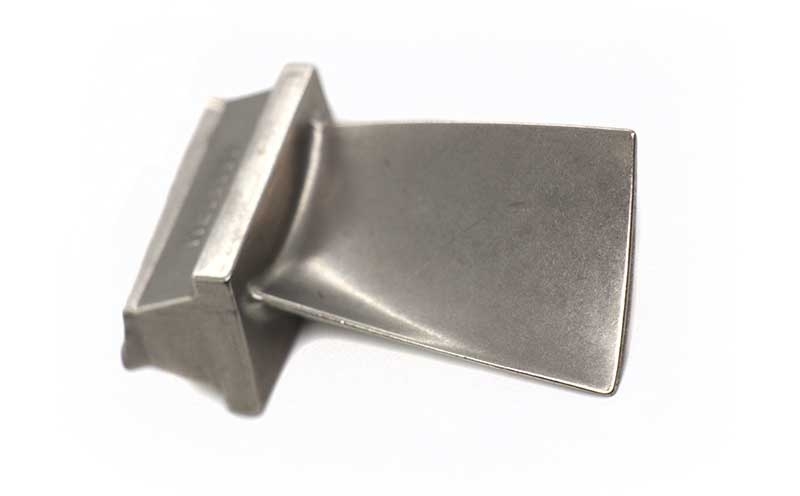
Gas turbine blades extract energy from hot gas and transfer it to a rotor through
their attachments. The airfoil produces aerodynamic loading while the blade’s own
mass creates centrifugal load. Thermal cycling, vibration, creep and
environmental attack can act together. ForceBeyond supports custom turbine blade
manufacturing and supply enquiries with the airfoil, root, platform, tip and
cooling features treated as one component. This hub compares design and process
choices; the material pages provide grade-specific detail.
Define a blade manufacturing package. Send the blade model, exact alloy
and crystal structure, plus the intended casting or finished-part delivery state. Request a custom quote.
Load paths from the airfoil to the disk
The rotating row described in NASA’s
turbine explanation produces shaft work. Within a separate blade, the root transfers
load into the disk and the platform defines part of the gas path. Root fit, airfoil
profile and tip clearance have different functions but share a datum system. A
profile-only inspection cannot establish attachment fit or the condition of an internal
cooling passage.
A hot steady dwell can contribute time-dependent creep, while starts and stops impose
changing thermal strain. Vibration adds a different fatigue concern. The design’s duty
cycle determines their relative importance, so published alloy chemistry cannot replace
blade-specific life data.
Compare airfoil structures before comparing suppliers
Blade structures and their production controls
Structure
Engineering distinction
Manufacturing evidence
Conventional cast
Multiple grains and grain boundaries
Specified grain condition, casting soundness and heat-treatment records.
Directionally solidified
Columnar grain alignment
Growth direction and permitted grain defects.
Single crystal
A selected crystal orientation
Orientation and unwanted-grain acceptance plus the specified thermal
route.
Cooling cores and holes create a second geometry inside the external airfoil. Wall
thickness, passage continuity and outlet condition influence local metal temperature.
Coating thickness or masking can affect openings and final dimensions; measurement
therefore needs a defined before- or after-coating state.
A casting plan addresses filling, solidification and core location. Finishing establishes
the root and other interfaces without losing the intended airfoil contour. Required NDT,
internal-feature checks and dimensional measurements answer different questions and must
be tied to the actual acceptance criteria.
A supplier route should specify the casting structure and core or solid-airfoil
definition first, then the thermal condition, root finishing, passage verification,
coating sequence and final acceptance state. A cooled blade needs evidence for both the
gas-path surface and internal walls. Separate stationary vanes use support and throat datums,
while an integral wheel has no separate blade-to-disk
attachment.
Use the CMSX-4 page for crystal
orientation and selected-grain acceptance; the unchanged René page separates conventional René 80 from
single-crystal René N5. The 718 page asks
whether the actual stage, stock form and aged condition fit the design, while 738 centers on a variant-specific cast hot
airfoil. The Hastelloy enquiry starts by
resolving a family name and whether the part is a rotating blade at all. These are
navigation clues, not material-selection recommendations.
Material selection needs a component context
IN 738 LC producer
data addresses cast airfoils, whereas Haynes’
HASTELLOY X data emphasizes combustion and exhaust hardware. Both concern
turbine-engine materials but do not establish equivalent rotating-blade capability.
Cooling scheme, material condition and approved stress/life data determine the acceptable
choice.
Coordinate casting, finishing and release
ForceBeyond can coordinate a defined casting and finishing package. Tooling, core
supply, thermal processing, coatings and dimensional release should have named owners.
Specialized crystal routes and customer-approved processors require program-specific
confirmation.
For a quote, distinguish a near-net casting from a fully finished blade and include the
material specification, cooling details, inspection package, quantities and schedule. The
inspection resources help identify the
evidence required at each handoff.
Turbine Blades — Technical and Supply FAQs
Why does a blade drawing need both airfoil and attachment datums?
The airfoil controls flow while the attachment locates and carries the blade in the disk. Their relationship sets the installed geometry; measuring either feature alone does not establish the complete blade.
What changes when a turbine blade is internally cooled?
The manufacturing plan must control cores or holes, local walls, passage continuity and outlet condition as well as the outer profile. Coating and inspection sequence also matter for access and final dimensions.
Is a single-crystal blade simply a stronger conventional casting?
No. It is a different controlled material structure with orientation-dependent behavior and defect criteria. Any benefit must be evaluated for the selected alloy, cooling design and duty cycle.
Can a blade order end at the casting stage?
Yes. Casting-only and finished-blade packages can be scoped separately. The agreed delivery condition determines which heat treatment, machining, coating and acceptance records remain downstream.
Request Custom Turbine Blade Manufacturing
Send the blade model, exact alloy and crystal structure, plus the intended casting or finished-part delivery state.