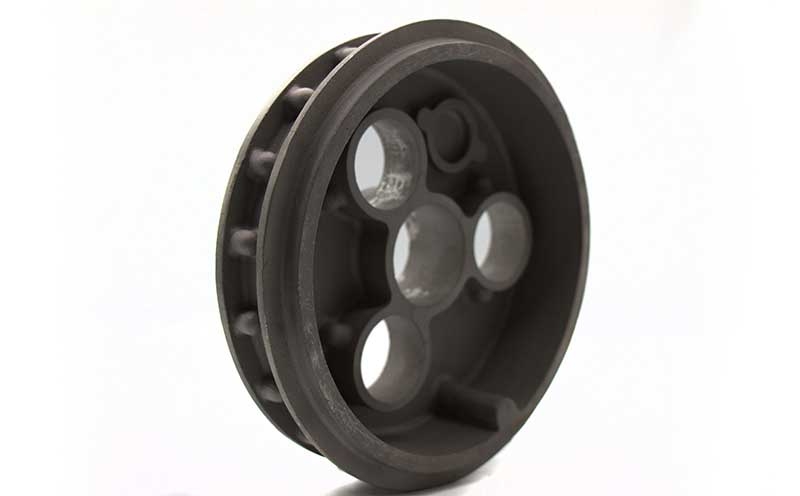
Custom René 95 turbine disk manufacturing and supply
A René 95 turbine disk uses a precipitation-hardened nickel-base alloy developed
for high-strength rotating hardware. The disk carries blades at its rim and
transfers their loads through the web to the bore and shaft connection. René 95
is relevant where the approved design requires strength and fatigue resistance
under rotational and thermal cycling; its response depends on the product route
and heat treatment. ForceBeyond supports custom turbine disk manufacturing and
supply enquiries, from a defined blank or finishing scope to a coordinated part
proposal, subject to program-specific feasibility and approval.
Discuss a custom René 95 disk. Send the drawing, specified material
route and delivery condition for a manufacturing review.
Request a custom quote.
René 95 alloy chemistry and disk material behavior
René 95 is strengthened by precipitates within its nickel-rich matrix. The producer
identifies niobium and tungsten as notable constituents and lists powder-metallurgy and
cast routes for rotating hardware. Its
nominal chemistry
helps identify the alloy; it is not a finished-disk acceptance range.
Selected René 95 nominal composition, weight percent
Element
Nominal wt %
Material-review context
Nickel
Balance
Base of the superalloy.
Chromium
14
Specified chemistry and environmental response.
Niobium
3.5
Helps distinguish the grade from other disk alloys.
Aluminium / titanium
3.5 / 2.5
Constituents associated with precipitation strengthening.
Tungsten / molybdenum
3.5 / 3.5
Additional alloying constituents.
These are SeAH's nominal values,
not acceptance properties or chemistry tolerances. In a
NASA study of as-HIP René 95,
solution treatment near the gamma-prime solvus changed the amount of gamma-prime phase
and the measured tensile and stress-rupture response. This is why heat-treatment condition
and microstructure matter alongside nominal chemistry. Density data and design
allowables for strength and life must come from the program-approved product form
and test conditions.
Processing changes fatigue behavior
A NASA-published comparison
tested hot-isostatically-pressed, extruded-and-forged, and cast-and-wrought René 95
after the same heat treatment at 540 °C and 650 °C. The forms differed in tensile,
low-cycle-fatigue and crack-growth behavior; the cast-and-wrought form showed lower
fatigue life but higher crack-propagation resistance in that study. These are test
conditions, not operating limits or a ranking of every route. The result makes grain
structure and processing history relevant to material and inspection planning.
How disk geometry shapes engineering requirements
Bore, web, rim and blade attachment
The bore locates the disk on its shaft or rotor interface. The web carries load between
the bore and rim, where blade attachments and thermal exposure add different demands.
Slots, fillets and transitions can concentrate cyclic stress; their geometry, surface
condition and inspection access matter alongside alloy properties. Temperature can
vary across a disk, so one room-temperature strength value cannot describe every region.
Low-cycle fatigue from engine starts and stops, time at load, and crack growth are
distinct design concerns. The approved life analysis determines which locations need
the tightest controls. The René 95 study
illustrates that a route favorable for one fatigue measure need not be favorable for
every crack-propagation measure.
Powder metallurgy, forging and disk finishing
NASA's historical René 95 program
documented powder-metallurgy rotating hardware, including a high-pressure turbine aft
shaft and compressor disk forgings. Those examples demonstrate a technical route; they
do not establish approval of a present-day source for this disk. A production plan must
follow the customer's specified powder handling, consolidation, working and heat-treatment
sequence wherever those steps apply.
For a specified powder route, powder production and handling precede consolidation;
HIP may form a dense preform, while forging and heat treatment establish the required
blank shape and structure. CNC finishing then creates bore, rim and attachment geometry.
Machining allowance, fillet transitions and final surface condition matter because these
features can govern local fatigue assessment. A manufacturing plan links the material
heat and blank to test results, required NDT and dimensional reports. The actual route
and process responsibilities must be confirmed for each program.
René 95 and Inconel 718 in disk evaluation
Both are nickel-base alloys studied for rotating hardware. The
INCONEL
718 technical bulletin describes gamma-prime and gamma-double-prime precipitation.
René 95 producer data
describes a different nominal chemistry and available material routes. A valid comparison
needs properties for the exact product conditions at the disk's relevant temperatures,
cyclic loads and dwell periods. Neither is a blanket upgrade or an approved substitute.
A NASA contractor study
compared René 95 powder-metallurgy forms with conventionally processed Inconel 718
under continuous cycling and a 15-minute tensile hold at 650 °C. That defined test
makes processing and loading history part of the comparison; it does not provide a
universal material substitution rule or a service-temperature rating.
Define a manufacturable and verifiable supply scope
A custom supply scope can cover a qualified blank, machining of customer-supplied
material, or a complete finished disk. These routes differ in who controls the incoming
material, heat treatment, final geometry and release package. Material identity should
follow the blank through machining and inspection, with critical bore and attachment
dimensions tied to their drawing datums and reported acceptance results.
ForceBeyond can coordinate a manufacturing proposal for the defined scope. Specific
René 95 capacity, source approvals and special-process approvals require confirmation
against the customer's program before production commitment.
What to include in a René 95 disk enquiry
Send the disk drawing, material specification and permitted blank route, then state
whether the requested deliverable is a blank, a machined customer-supplied blank or a
finished disk. Include the inspection package, quantity and target schedule. That lets
ForceBeyond define the manufacturing scope and identify any feasibility step before
production pricing.
René 95 Turbine Disk — Technical and Purchasing FAQs
Why is the processing route important for a René 95 disk?
Published René 95 fatigue research found different behavior for hot-isostatically-pressed, extruded-and-forged, and cast-and-wrought material under the studied conditions. Disk properties therefore cannot be inferred from the alloy name alone; the approved route, heat treatment and acceptance tests belong in the part specification.
Is René 95 automatically a substitute for Inconel 718 in a turbine disk?
No. Both are nickel-base alloys studied for rotating hardware, but their chemistry, strengthening response and processing histories differ. Selection requires the design authority to assess the specific disk geometry, temperature and loading cycle, life requirements and approved material specification.
Which disk features need particular manufacturing attention?
The bore and attachment features can contain stress concentrations, while the web and rim experience different thermal and mechanical demands. Their datums, surface condition and inspection coverage should be defined by the approved disk drawing and life analysis.
Can ForceBeyond review machining of a customer-supplied René 95 blank?
Yes. A review can be scoped to finishing a customer-supplied blank if its pedigree, incoming condition, drawing, approved processes and remaining inspection responsibilities are available. Feasibility and source approval must be confirmed before a production commitment.
Request a René 95 Turbine Disk Manufacturing Quote
Send the disk drawing, material route and delivery scope for a custom manufacturing review.