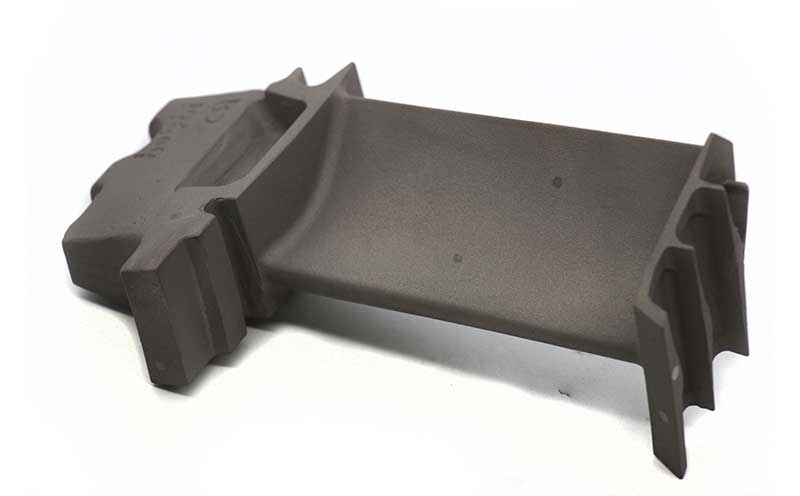
738 vane casting must preserve passage and platform relationships
An Inconel 738 turbine vane uses a defined cast nickel alloy in a stationary
flow-guiding component. Unlike a rotating blade, the vane transfers gas and
thermal loads through its platforms and supports rather than a centrifugal disk
attachment. Variant, grain condition, cooling and coating influence the
manufacturing plan. ForceBeyond supports custom vane casting and supply enquiries
with machining, segment interfaces and inspection defined for the requested
delivery state.
Scope a 738 vane or segment. Send the exact 738 variant, vane/assembly
drawings, cooling and coating requirements and final inspection condition. Request a custom quote.
LC nominal chemistry is a reference, not a generic 738 specification
SeAH identifies IN 738
LC as a lower-carbon variant of IN 738C used for cast blades and vanes. The variant
remains part of the production definition, including the permitted thermal route and
material tests. A buyer should not apply LC chemistry to every drawing labeled 738.
Selected IN 738 LC composition for vane material review
IN 738 LC selected nominal values, wt%
Constituent
Nominal value
Chromium
16
Molybdenum / tungsten
1.7 / 2.5
Aluminium / titanium
3.6 / 3.4
Carbon
0.1
Producer nominal
values are illustrative of LC grade identity. They are not acceptance limits,
evidence of a qualified vane source or a component temperature rating.
Platform restraint changes the thermal problem
A vane’s platforms locate the airfoil and define the ends of the passage. Nonuniform
heating can impose strain at airfoil/platform transitions and at constrained supports.
Cooling passages and coating are part of the designed temperature distribution; they
cannot be judged from external profile conformance alone.
For a segment, throat relationships and end gaps depend on more than one airfoil.
Machining and measurement must relate these features to the specified locating datums.
The final acceptance state should say whether the vane is loose, in a fixture or part of
an assembled ring.
Cast walls and machined interfaces require different controls
The casting process controls the
airfoil, core position and prescribed structure. Thermal treatment, required HIP and
permitted repair follow the approved process plan. Subsequent machining establishes supports and
locating faces while respecting the gas-path contour.
An inspection package may combine specified casting-soundness NDT, internal wall/passage
checks, material tests and dimensional reports. Coating adds masking and final-surface
acceptance. The required methods and limits need a common drawing revision so a
conforming casting does not lose conformance during finishing.
For a cooled segment, correlate the core print or approved internal inspection result
with wall locations near the leading edge, trailing edge and platform junction. Measure
throat and platform datums in the specified loose, fixtured or assembled state, then
verify coating does not obstruct exits or shift locating surfaces. A surface NDT pass
cannot establish those internal-wall or assembled-passage relationships.
A 738 rotating blade also uses cast airfoil
geometry, but carries centrifugal load through its root into a disk. The stationary vane
instead transfers gas and thermal-restraint loads through platforms and supports. Their
acceptance plans cannot be interchanged simply because the producer lists both
applications for IN 738
LC.
738 LC versus cobalt Mar-M 509 for nozzles
MAR M 509 is a
cobalt-base nozzle-alloy example with a different strengthening system. Hot corrosion,
thermal strain, coating and service-life data must be evaluated for the component.
Neither a stationary-vane label nor a generic high-temperature claim authorizes material
replacement.
Coordinate a finished stator package
ForceBeyond can scope a casting, finished vane or specified ring/segment delivery. Variant-specific
production capability and source approvals require confirmation. Include material and
process specifications, cooling model, supports, coating, inspection condition,
quantities and schedule. The 738 blade page
addresses the different rotating-airfoil load path.
Inconel 738 Turbine Vane — Technical and Supply FAQs
How does a 738 vane differ mechanically from a 738 blade?
A vane is stationary and carries gas and thermal loads through supports and platforms. A rotating blade adds centrifugal loading through its attachment. Their material and geometry requirements remain design-specific.
Why must a 738 vane order retain the LC suffix when specified?
LC identifies a particular variant and its applicable chemistry and processing requirements. It cannot be omitted simply because both variants are called 738.
What can external vane profile measurements miss?
They do not alone establish internal wall/passage geometry or final segment throat relationships. Those require the checks and assembled condition prescribed by the design.
Can a 738 vane be delivered as part of a ring?
A ring or segment package can be reviewed with assembly datums, joining where applicable and final inspection defined. The quote must state whether it covers loose vanes or a complete unit.
Request a Custom Inconel 738 Vane Quote
Send the exact 738 variant, vane/assembly drawings, cooling and coating requirements and final inspection condition.