
Are a nozzle ring and a diaphragm always the same construction?
No. Equipment terminology varies. The assembly drawing must establish whether the part is one piece, segmented, joined or a controlled set.


A turbine nozzle ring or diaphragm holds stationary airfoils in the arrangement defined by its engine or machine design. Vane position, throat geometry and the ring’s locating surfaces establish the flow path seen by the rotor. Names and constructions vary: a one-piece ring, segmented nozzle and joined diaphragm do not impose the same manufacturing tasks. ForceBeyond supports a defined ring or diaphragm manufacturing and supply enquiry with constituent parts, assembly operations and final inspection considered together.
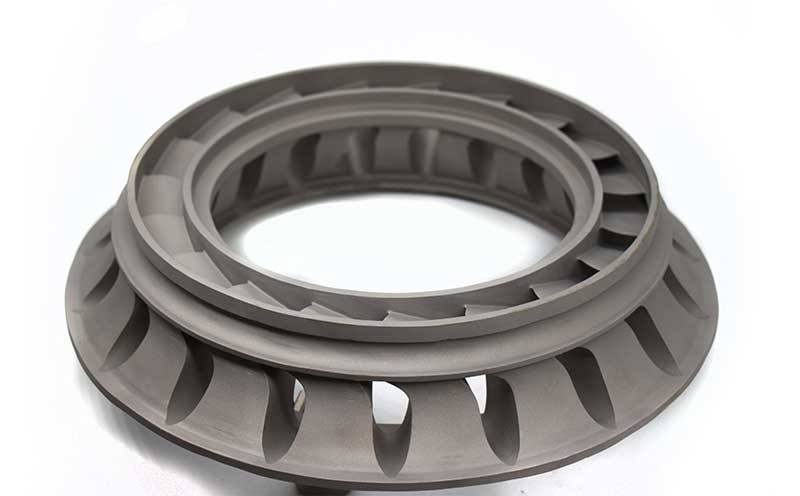
Define the ring assembly deliverable. Send the assembly and part drawings, construction and joining route, material specifications and final inspection state. Request a custom quote.
NASA’s turbine description identifies stationary and rotating airfoil rows. A ring’s supports locate the stationary row around the rotor. Circularity, concentricity, vane clocking and platform position describe different geometric relationships. Their tolerances and inspection fixture should follow the assembly drawing, not a generic ring diameter.
The throat depends on adjacent vane positions and their profile, while mounting and seal interfaces locate the whole unit. Measuring loose airfoils may be necessary but cannot establish the final assembled passage or fit.
| Configuration | Manufacturing emphasis | Acceptance condition |
|---|---|---|
| One-piece casting | Fill, solidification, allowance and distortion | Complete casting and finished annular datums. |
| Segmented ring | Segment datums, joints and set identification | Defined fixture or assembled relationship. |
| Joined diaphragm | Part fit, joining process and thermal distortion | Specified post-join geometry and NDT. |
| Loose matched components | Part/set control and downstream interfaces | Delivery state before customer assembly. |
Joining and construction alternatives are not automatic substitutes; the approved assembly design controls them.
Nozzle alloys such as MAR M 509 and IN 738 LC illustrate different material systems. A multi-part assembly may have distinct specifications for airfoils and supporting members. The process plan must retain those identities and the required final condition.
Where joining is permitted, its thermal cycle and fixturing can change alignment or dimensions. Machining may therefore establish final datums after the required processing. Coating and cooling features, if present, add another final-state definition. Weldability in a data sheet is not permission to repair or join a specific assembly.
The inspection plan should link constituent material and process records to the delivered ring or controlled set. Required surface or joint examination, dimensional checks and any passage verification have separate purposes. The fixture, assembly state and drawing revision should be recorded where they affect the result.
Packaging and handling also need to preserve thin edges, locating surfaces and matched-set identity. A ring that loses its controlled segment arrangement may need a different acceptance step than an individually interchangeable component.
For a segmented ring, record segment order and clocking against a fixture or mating-case datum before measuring cumulative throat distribution and end gaps. For a joined diaphragm, verify circularity, concentricity and vane position after the final joining thermal cycle and finish machining; an earlier loose-piece profile report cannot prove the final annulus. A one-piece casting instead needs casting-to-finished-datum transfer and the specified soundness evidence at thick supports.
A useful release record maps each vane or segment identifier to material heat, permitted repair or join records, inspection results and final assembled position. This lets the buyer separate a complete accepted ring from a matched set awaiting customer assembly.
A single NGV order can stop at one part’s datums. A ring quote must define fit-up, joining or matched-set responsibilities, final assembly measurement and all included constituent parts. The inter-stage TGV section provides the related flow-path context.
ForceBeyond can coordinate a one-piece, segmented or joined supply proposal within the customer-approved route. Capacity and special-process qualification need confirmation. The RFQ should include assembly/part drawings, alloys, joining restrictions, final inspection criteria, tooling and fixture status, quantities and delivery state.
No. Equipment terminology varies. The assembly drawing must establish whether the part is one piece, segmented, joined or a controlled set.
Clocking relates each airfoil to the annular datum system. Together with profile and spacing it establishes the assembled passage and its relationship to the rotor.
They do not by themselves establish assembled alignment, joints, circular datums or final throat relationships. The specified assembled-state checks remain necessary.
Whether supply ends with loose parts, a matched set or a complete joined and inspected assembly. That boundary determines process, fixture, documentation and delivery responsibilities.
Send the assembly and part drawings, construction and joining route, material specifications and final inspection state.
Expand this section to review the external standards, technical organizations, and reference materials used for this page.
Explore related ForceBeyond material, process, quality, industry, and manufacturing resources.