Does Hastelloy identify a single turbine blade alloy?
No. It is an alloy family name. The full grade, product form, condition and component requirements are needed to establish the actual material and manufacturing route.


A Hastelloy turbine blade enquiry needs a complete alloy designation and a clear component function. Hastelloy covers alloys with different strengthening and environmental behavior; it is not one rotating-blade specification. HASTELLOY X is a useful technical example, but its producer’s documented combustion and exhaust applications do not prove suitability for a loaded turbine blade. ForceBeyond supports a defined custom manufacturing and supply enquiry after the grade, product form and design requirements are established.
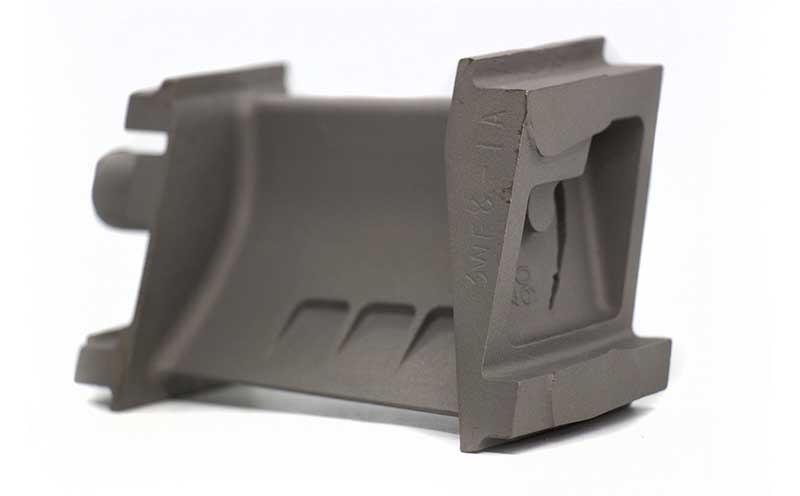
Resolve the grade and airfoil supply scope. Send the full Hastelloy designation, component drawing, rotating or stationary function and required product form. Request a custom quote.
Haynes International’s X alloy data describe a nickel-chromium-iron-molybdenum material used in combustion and exhaust hardware. Its combination of fabricability, oxidation resistance and high-temperature behavior is relevant to those applications. It does not establish the fatigue, attachment or creep qualification of a separate rotating blade.
| Element | Nominal value |
|---|---|
| Chromium | 22 |
| Iron | 18 |
| Molybdenum | 9 |
| Cobalt / tungsten | 1.5 / 0.6 |
Haynes’ X table supplies these nominal values. They do not describe C-family or other Hastelloy grades and are not blade design allowables.
NASA’s turbine description distinguishes rotating and stationary rows. A rotating blade transfers centrifugal and aerodynamic loads through its root; a nozzle or combustor component has another support system. The same gas-path environment can therefore require different material evidence and manufacturing geometry.
A drawing should make the root or mounting interface, airfoil, platform and thermal features unambiguous. If the component is actually a combustion liner, fabricated vane or other stationary part, its process route may differ substantially from a cast rotating airfoil. Function is an engineering input, not just a search label.
For a real rotating airfoil, request the blade-root drawing, grade-specific cast or wrought specification, approved life data and responsible design authority. For a stationary vane, request support and throat geometry; for a combustor liner or exhaust fabrication, request sheet form, joining and environmental requirements. Haynes documents HASTELLOY X for the latter hot-gas hardware context, not as proof that a particular rotating blade is approved.
The approved URL describes a possible buyer enquiry, not an established Hastelloy rotating-blade product. Without a documented grade, component application and qualified manufacturing route, the page should remain a material-definition guide. Publication as a direct rotating-blade supplier claim needs a separate engineering and commercial decision.
Sheet fabrication, wrought-stock machining and investment casting produce different structures and acceptance records. A wrought X data sheet must not be used as the property basis for a cast blade without the relevant specification. Joining, heat treatment and coating also require a process sequence appropriate to the actual grade and component.
For a permitted custom route, finishing establishes datums, edges and interfaces while the quality plan retains material identity. Surface examination, required internal-soundness checks and dimensional reports should match the product form; they are not interchangeable proof of performance.
IN 738 LC producer data address a cast turbine-airfoil alloy. The comparison shows why documentation of oxidation resistance in combustion hardware is different from a complete rotating-blade qualification. Neither alloy should be selected solely because its producer lists gas turbine use.
ForceBeyond can coordinate a defined casting or machining proposal subject to grade-specific feasibility and approval. Complete legacy specifications, historic approved records and the current drawing help the design authority close ambiguous alloy references.
The quotation request should state the full grade and specification, product form, component function, final dimensions, thermal or joining operations, required inspection and quantities. Any unresolved material-definition work should be identified before tooling or production price is committed.
No. It is an alloy family name. The full grade, product form, condition and component requirements are needed to establish the actual material and manufacturing route.
No. A rotating blade has centrifugal, attachment and cyclic-life requirements in addition to environmental exposure. The design authority must approve the material for that specific component.
Not as a substitute for the applicable cast-product specification and qualified design data. Product form and thermal history affect the evidence required for acceptance.
A material-definition review using referenced specifications and approved historical records. ForceBeyond can scope manufacture after the responsible engineering authority resolves the grade and delivery condition.
Send the full Hastelloy designation, component drawing, rotating or stationary function and required product form.
Expand this section to review the external standards, technical organizations, and reference materials used for this page.
Explore related ForceBeyond material, process, quality, industry, and manufacturing resources.