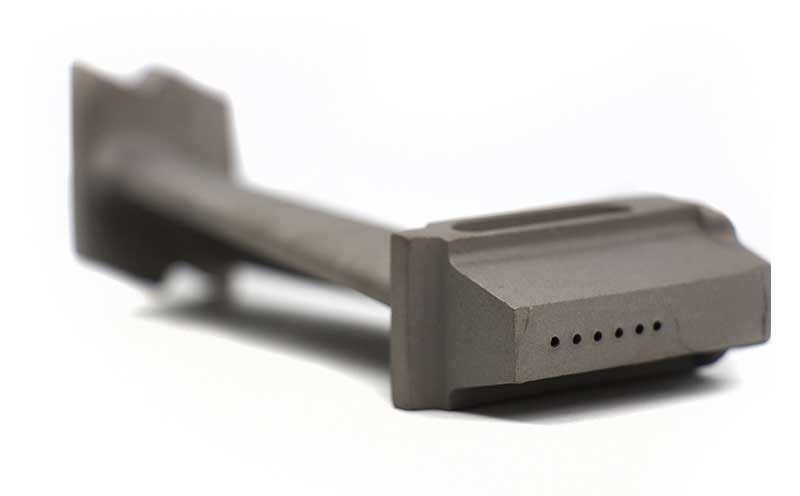
CMSX-4 airfoils require crystal control as well as shape control
A single crystal CMSX-4 turbine blade uses a nickel-base alloy developed for a
controlled crystal structure. The airfoil, platform, root and cooling features
must work with that structure under the engine’s thermal and mechanical cycle.
Crystal orientation and unwanted grains are material acceptance subjects, not
simply dimensional features. ForceBeyond supports a defined custom blade
manufacturing and supply enquiry, with specialized casting capability and
processor qualification confirmed for the actual program.
Discuss a CMSX-4 blade supply scope. Send the exact alloy variant,
crystal-orientation requirements, blade model and casting or finished-part delivery
state. Request a custom quote.
A named single-crystal alloy is a specific material system
Cannon-Muskegon’s
alloy table classifies CMSX-4 as a nickel-base single-crystal alloy and distinguishes
modified variants. Its chemistry and prescribed thermal route work with the intended
crystal structure. Ordering an equiaxed casting with similar chemistry would not
reproduce the specified material.
Selected chemistry identifies the grade, not its life
CMSX-4 selected nominal chemistry, wt%
Constituent
Nominal value
Cobalt
9
Chromium
6.5
Tungsten / tantalum
6 / 6.5
Aluminium / rhenium
5.6 / 3
Producer values
refer to the listed CMSX-4 grade, not all derivatives, acceptance ranges or mechanical
allowables. The governing customer specification controls the purchased variant.
Orientation changes the blade engineering assessment
NASA’s single-crystal research
identifies orientation and unwanted grains as acceptance concerns. A single crystal has
direction-dependent response, so an external profile that meets dimensions can still fail
the material’s orientation criteria. Root loading, airfoil bending and thermal strain
must be assessed with the specified orientation.
Cooling passages create local thin walls and temperature gradients. Their relationship to
the airfoil and platform controls where hot regions develop; coating and hole finishing
must preserve the design’s openings. A material name alone cannot predict blade life or
replace the cooling design.
Compared with an equiaxed casting, a selected single crystal removes ordinary transverse
grain boundaries, while a directionally solidified casting retains boundaries aligned
with growth. Elastic and fatigue response depend on crystal direction relative to the
airfoil and attachment loads; an accepted orientation is therefore part of the design
basis, not a cosmetic casting attribute. No orientation-dependent life value is inferred
from the nominal CMSX-4 chemistry.
Casting development and thermal processing are linked
NASA’s solidification
description explains directional growth and grain selection. For a production blade,
core placement, growth control, allowed defects and heat-treatment sequence belong to one
controlled process plan. Surface work before a later thermal cycle must also be assessed
for its effect on the required structure.
Finish machining establishes root fit, platform interfaces and tip dimensions. Inspection
can include the specified grain/orientation examination, casting soundness checks,
internal passage verification and dimensional reporting. The applicable methods, sequence
and limits come from the blade program rather than a generic list of NDT services.
In a directional-solidification route, the mold is withdrawn through a controlled thermal
gradient while a selector admits one grain into the airfoil. That process establishes the
intended growth direction; it does not by itself prove the final blade meets the
drawing's orientation or defect limits. NASA's solidification review
supports the process distinction.
Crystal-orientation measurement checks the lattice direction against the blade datum and
specified angular tolerance. Grain etching or another approved structure examination
looks for stray grains, low-angle boundaries and recrystallized surface regions;
dimensional metrology checks the airfoil and root shape; passage inspection checks
core-defined walls. These are different acceptance questions. NASA's single-crystal defect study
explains why small surface grains and orientation matter, but the program sets the
inspection method and reject limits.
CMSX-4 versus other single-crystal blade alloys
The René blade benchmark explains the
separate René N5 alloy. Sharing a single-crystal category does not make these grades
interchangeable: chemistry, heat treatment, coating compatibility and qualified life data
remain grade-specific. This page focuses on CMSX-4 variant identification and
crystal-control evidence rather than a broad René-family selection guide.
Coordinate a casting or finished-blade package
ForceBeyond can scope a manufacturing and supply proposal around the required casting and finishing operations. A specialized
single-crystal source, its approval status and production capacity must be confirmed
before commitment.
The RFQ should identify the CMSX-4 variant, drawing revision, orientation and grain
acceptance, cooling model, thermal and coating requirements, final inspection records,
quantity and schedule. Customer-supplied castings can be a distinct downstream scope when
their material pedigree and remaining process responsibilities are established.
Single Crystal CMSX-4 Turbine Blade — Technical and Supply FAQs
Why is crystal orientation part of CMSX-4 blade acceptance?
Single-crystal material responds differently with direction. The permitted orientation relative to the blade geometry is therefore part of the material definition, alongside dimensions and casting soundness.
Can a CMSX-4 derivative be quoted as standard CMSX-4?
Not without the exact grade and specification being agreed. Producer tables distinguish derivatives, and chemistry or thermal-processing changes can affect qualification and acceptance.
Does a single crystal eliminate the need to inspect casting defects?
No. Unwanted grains, orientation, internal soundness, cooling geometry and dimensional features remain distinct acceptance subjects under the program’s criteria.
Can CMSX-4 finishing be supplied separately from casting?
A downstream package can be reviewed for customer-supplied qualified castings. The scope must identify material pedigree, remaining heat treatment, machining, coating and inspection responsibilities.
Request a Custom CMSX-4 Blade Quote
Send the exact alloy variant, crystal-orientation requirements, blade model and casting or finished-part delivery state.