Is Mar-M 509 a nickel-base nozzle alloy?
No. The producer identifies it as cobalt-base, strengthened by solid solution and carbide precipitation. Its material basis differs from nickel-base gamma-prime blade alloys.


A Mar-M 509 nozzle guide vane uses a cast cobalt-base superalloy in a stationary hot-section component. Its material system differs from gamma-prime nickel blade alloys: the producer describes solid-solution and carbide strengthening with oxidation and corrosion resistance. The actual vane still needs design-specific thermal, dimensional and life acceptance. ForceBeyond supports custom Mar-M 509 vane casting and supply enquiries with platform machining, coating where required and traceable release records in the defined scope.
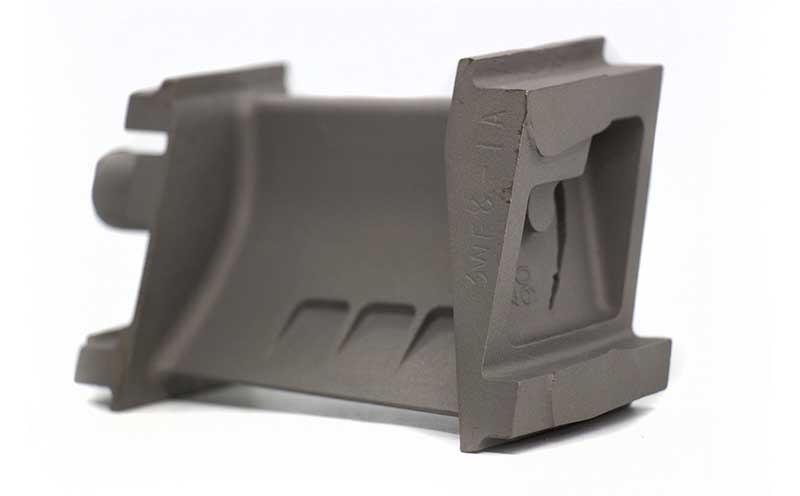
Scope a Mar-M 509 nozzle casting. Send the vane drawing, material revision, thermal and coating requirements, inspection criteria and quantity. Request a custom quote.
SeAH’s MAR M 509 reference identifies a cobalt-base alloy strengthened by solid solution and carbide precipitation, with nozzle guide vane applications. That is a material-selection context, not evidence that any nozzle geometry or source is already qualified. Grain condition, casting soundness and the specified thermal history remain relevant.
SeAH identifies solid-solution and carbide precipitation strengthening in this cobalt-base cast nozzle alloy. The casting and thermal history must therefore preserve the specified carbide-bearing structure as well as the external profile. At platform transitions, restraint during repeated heating can change local strain; material identity, permitted structure and mounting geometry all belong in the nozzle acceptance plan.
For a cobalt casting, verify the specified heat/lot chemistry and material test state, then examine platform-to-airfoil transitions with the approved surface or internal method. A final throat and support-datum report checks a different attribute. The IN 738 LC vane uses a nickel-base cast system and different variant controls; it is a comparison, not an alternate part number.
| Constituent | Nominal value |
|---|---|
| Cobalt | Balance |
| Chromium / nickel | 23.5 / 10 |
| Tungsten / tantalum | 7 / 3.5 |
| Carbon | 0.6 |
Producer nominal chemistry is not a purchase tolerance or a finished-vane acceptance value. No universal operating temperature is assigned here.
A nozzle vane guides hot flow through a constrained airfoil and platform assembly. Heating and cooling create differential expansion; local restraint at platforms and mounts changes the strain pattern. Environmental exposure and thermal cycling can therefore remain important even without rotating-blade centrifugal load.
Airfoil thickness, platform transitions and specified cooling influence local temperature and stress. Final geometry must preserve the designed passage and locating surfaces. The application’s coating and cooling system must be considered with the base material rather than used as a reason to relax its acceptance.
The casting route must establish the prescribed structure and soundness through the vane and platform transitions. Any cores, thermal processing or permitted repair require their own process controls. Final machining establishes locating faces and other interfaces without changing the airfoil beyond its tolerances.
Inspection planning links the heat and casting lot to material records, required surface/internal NDT, profile measurements and platform datums. If coatings or assembly operations follow, the release condition must state which dimensions and passage checks apply afterward.
IN 738 LC is a nickel-base cast-airfoil reference with a different composition and strengthening response. Comparing only corrosion or temperature labels does not select a nozzle alloy. Thermal strain, mechanical loads, repair rules, coating system and qualified design properties determine the acceptable material.
ForceBeyond can coordinate a Mar-M 509 casting or finished-segment proposal subject to program-specific process approval and capacity confirmation. The Stage 1 NGV hub section provides the assembly context. An RFQ should define alloy revision, vane/segment drawing, cooling and coating, inspection package, permitted repair, quantities and schedule.
No. The producer identifies it as cobalt-base, strengthened by solid solution and carbide precipitation. Its material basis differs from nickel-base gamma-prime blade alloys.
Its airfoil and platforms heat and cool nonuniformly while mounting constraints affect expansion. Removing centrifugal load does not remove thermal strain or environmental exposure.
It helps identify the alloy. The governing specification must also define product condition, required tests, casting quality and finished geometry; nominal chemistry is not a vane life rating.
A segment package can be reviewed with constituent geometry, joining if applicable, coating and assembled inspection defined. Actual source and special-process approvals must be confirmed.
Send the vane drawing, material revision, thermal and coating requirements, inspection criteria and quantity.
Expand this section to review the external standards, technical organizations, and reference materials used for this page.
Explore related ForceBeyond material, process, quality, industry, and manufacturing resources.