
Why does a compressor vane need a specified 718 condition?
Thermal processing changes the precipitation-strengthened material response. The product form and final condition must match the property basis used by the compressor design.


An Inconel 718 compressor vane is a stationary flow-control component made to a defined nickel-alloy product specification. Its airfoil may be fixed or supported by a variable-vane spindle. Material condition affects the property basis, while mounting and journal geometry establish the installed airfoil angle. ForceBeyond supports custom 718 compressor vane manufacturing and supply with blank definition, thermal processing, precision finishing and required inspection in a coordinated scope.
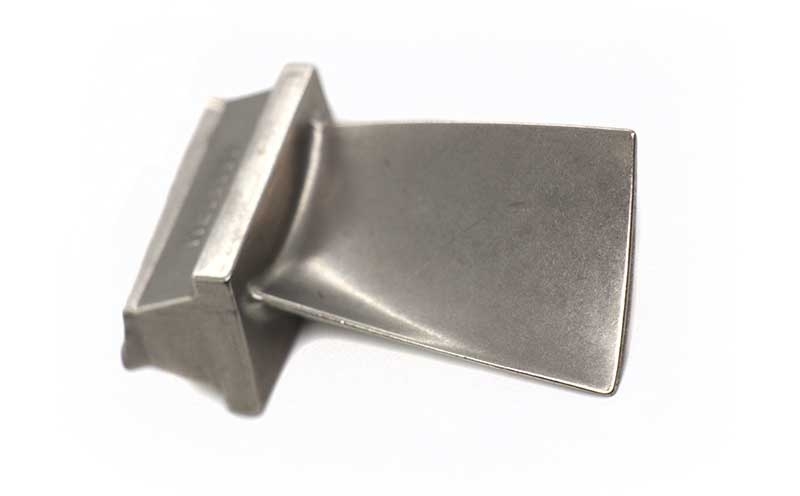
Scope a 718 fixed or variable vane. Send the compressor stage, material condition, vane model, mounting or spindle drawing and required delivery state. Request a custom quote.
The 718 technical bulletin describes precipitation heat treatment and condition-dependent properties. A compressor vane uses those properties within its actual temperature and vibration environment. The product form and final condition must therefore remain attached to its material requirement rather than being replaced by a generic nickel-alloy description.
| Stage | Material or geometry issue | Evidence |
|---|---|---|
| Incoming blank | Required product form and pedigree | Material specification and traceability. |
| Thermal processing | Required precipitation condition | Cycle and specified acceptance records. |
| Airfoil finishing | Profile and edge geometry | Measurements tied to mounting or spindle datums. |
| Journal/lever finishing | Coaxiality, fit and clocking | Final interface reports and surface condition. |
The actual sequence and test limits depend on the governing program; this is not a universal heat-treatment recipe.
NASA’s compressor description places inlet guide vanes before the first rotor and distinguishes subsequent stator rows. The stage identifies the incoming flow context. For a variable vane, airfoil angle is also related to the actuation axis and lever attachment.
Journal coaxiality and profile clocking must be inspected with the same datum system. A fixed vane instead relies on its mounting or segment surfaces. Thin airfoil finishing requires fixtures that limit deflection without concealing final distortion; final-fit measurements alone cannot verify the whole profile.
A permitted cast, wrought or customer-supplied blank has distinct material acceptance. Rough and final machining must work with the prescribed thermal sequence. Bearing/contact surface treatments, if specified, can change the final measurement state.
Material documentation, required surface or internal NDT, profile checks and interface reports should remain traceable to the part or lot. A movement or fit check can be added where the assembly requires it, but it does not replace the material and dimensional acceptance.
Confirm a permitted wrought or cast product specification, rough the airfoil and support features, apply the prescribed solution/aging route, then finish the profile and mounting surfaces in the required condition. A variable vane needs spindle/journal coaxiality and airfoil clocking; a fixed stage vane may have no spindle and instead needs segment or platform datums. Compare the named-grade 17-4 PH option through approved environment, strength/toughness condition, density and contact-surface needs, never as a chemistry-only substitute.
ATI’s 17-4 PH sheet describes a precipitation-hardening stainless system, while 718 is a nickel-alloy system. Selection requires the compressor environment, stiffness, loading and final-condition data. The 17-4 PH vane page focuses on aging condition and spindle/airfoil acceptance rather than treating the grades as interchangeable.
ForceBeyond can review blank supply, finishing or a specified vane/hardware package. Actual grade capability, capacity and processor approvals require confirmation. An RFQ should state the material revision and condition, stage, airfoil/mounting geometry, surface requirements, inspection records, quantities and schedule, including which assembly parts remain customer supplied.
Thermal processing changes the precipitation-strengthened material response. The product form and final condition must match the property basis used by the compressor design.
Their position relative to rotor rows and incoming flow differs. The assembly and stage reference identify the actual component and its operating context.
Spindle axis, journal fit and lever-interface clocking establish how actuator motion sets the airfoil angle. They need a common datum relationship to the profile.
A complete scope can be reviewed when surface processes and final measurement state are defined. The proposal must identify required processors and acceptance records.
Send the compressor stage, material condition, vane model, mounting or spindle drawing and required delivery state.
Expand this section to review the external standards, technical organizations, and reference materials used for this page.
Explore related ForceBeyond material, process, quality, industry, and manufacturing resources.