
Why specify the aging condition for a 17-4 PH vane?
Aging changes the strength/toughness combination and material response. The final condition must match the design and material acceptance requirements.


A 17-4 PH compressor guide vane combines a precipitation-hardening stainless material with a fixed or variable flow-control airfoil. The final aging condition changes the property combination, so the alloy name alone cannot define strength, toughness or dimensional acceptance. Spindles, contact surfaces and airfoil clocking add their own requirements. ForceBeyond supports custom 17-4 PH vane manufacturing and supply with material condition, finishing and inspection connected to the actual compressor assembly.
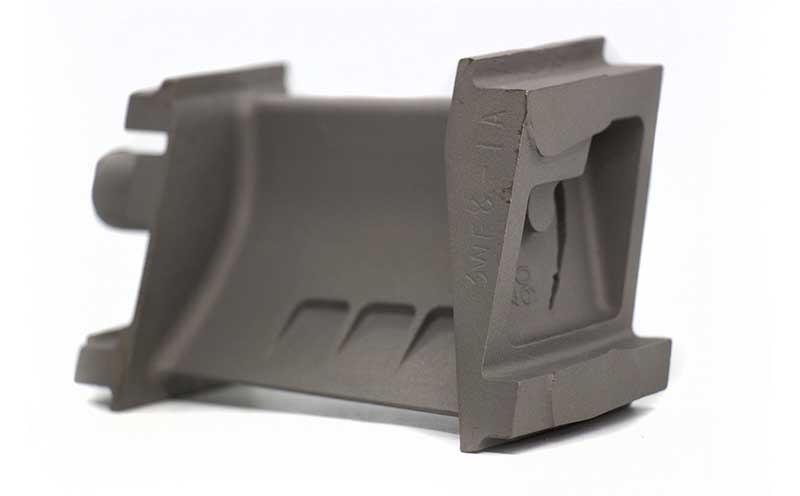
Scope a 17-4 PH finished vane. Send the material specification and aging condition, airfoil/spindle model, critical surfaces and required acceptance records. Request a custom quote.
ATI’s 17-4 PH reference identifies a chromium-nickel-copper precipitation-hardening stainless steel. Aging conditions trade strength and toughness; the prescribed condition is therefore part of the engineering definition. Data for a particular sheet or plate condition must not be used as a vane allowable without the applicable product specification.
| Element | Typical value |
|---|---|
| Chromium | 15.5 |
| Nickel | 4.5 |
| Copper | 3.5 |
| Iron | Balance |
These are the ATI data sheet’s typical figures, not universal acceptance limits or mechanical properties for a finished vane. The actual product form and condition control the order.
A thermal-condition label identifies a particular heat-treatment requirement. It must remain connected to the material tests and final drawing state. Selecting a higher-strength condition without reviewing toughness and environment can change the design basis rather than merely improve the part.
Thermal processing can also affect the finishing sequence. Stock allowance and datums must support the final airfoil, journals and interfaces after the prescribed condition is established. The production plan determines which surfaces are rough machined, thermally processed and finally finished.
ATI's 17-4 datasheet identifies copper-rich precipitation as the hardening response and lists distinct H900, H1025 and H1150 aging conditions. H900 is the higher-strength example; H1150 is overaged with lower typical strength and hardness, while H1025 lies between in the cited sheet. These are condition-labelled producer examples, not finished-vane allowables, and the governing product-form specification controls procurement.
Roughing before aging may leave allowance for profile and journal correction, while final machining and surface treatment establish the actual inspection state. The plan should specify when airfoil clocking, spindle coaxiality and hardness are measured relative to aging; an as-machined fit result from an earlier condition does not accept the delivered vane.
NASA’s compressor explanation places guide vanes in the inlet-flow conditioning system. In a variable vane, the lever and spindle connect commanded motion to airfoil angle. Journal coaxiality, contact surfaces and airfoil clocking are separate from the aerodynamic profile itself.
Inspection fixtures should relate those features without forcing a thin airfoil into a false shape. Required hardness or material tests support condition acceptance, while dimensional reports establish profile and fit. NDT is added according to the specific defect and acceptance requirements.
The stainless vane guide explains the broader steel families. A named PH condition offers a more specific material basis, but it does not establish suitability for every compressor temperature, contact or corrosion environment. Other families use different hardening routes and cannot be selected from the same generic property table.
ForceBeyond can coordinate machining and specified finishing for a customer-defined blank or complete vane scope. Product-form capability, thermal processors and program approval require confirmation. The quote should identify alloy revision and aging condition, mounting/actuation interfaces, surface treatment, inspection package, supplied hardware, quantities and schedule.
Aging changes the strength/toughness combination and material response. The final condition must match the design and material acceptance requirements.
No. Toughness, environment, contact behavior and the approved design basis must be considered. A different aging condition is not an automatic upgrade.
No. Hardness may support material-condition checks, but profile, journal geometry, clocking, required NDT and traceability remain separate subjects.
It identifies the product specification and aging condition, then defines the airfoil, interfaces, finishing, inspection and included hardware rather than only a material family.
Send the material specification and aging condition, airfoil/spindle model, critical surfaces and required acceptance records.
Expand this section to review the external standards, technical organizations, and reference materials used for this page.
Explore related ForceBeyond material, process, quality, industry, and manufacturing resources.