Can a wrought and a cast 718 wheel be treated as the same product?
No. Product route, thermal history and acceptance requirements can differ. The component design must approve the specified form and condition.

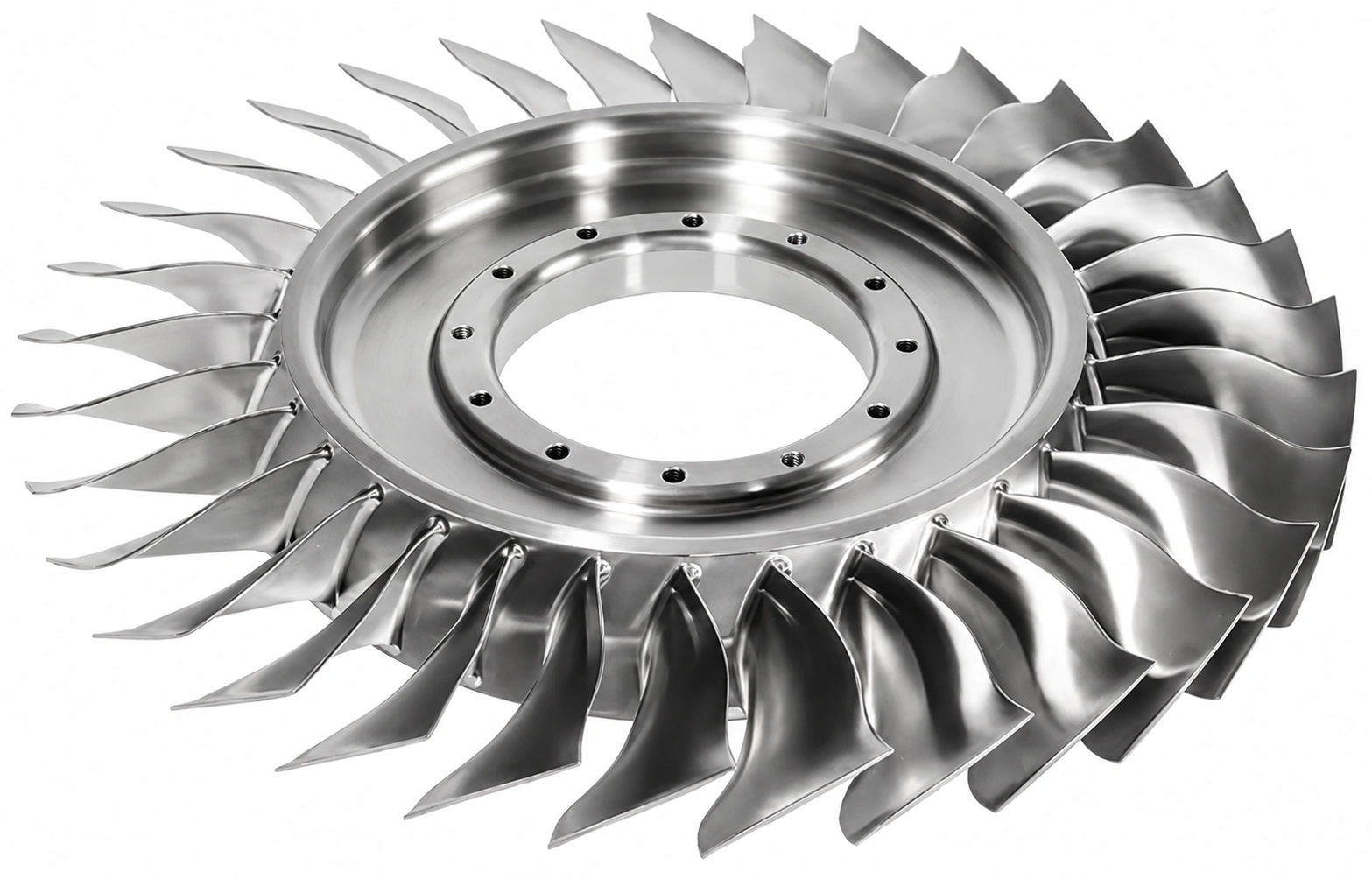
An Inconel 718 turbine wheel integrates airfoils and a hub in a rotating component defined by its equipment design. Product form and age-hardening condition establish the material basis; passage shape, hub transitions and the shaft interface establish the finishing problem. ForceBeyond supports custom 718 wheel manufacturing and supply enquiries for a loose wheel or a specified wheel-shaft package. Actual thermal service, source qualification and assembly operations require program-specific evaluation.
Define a 718 wheel or wheel-shaft package. Send the rotor model, product specification and final condition, shaft interface and required assembly/verification scope. Request a custom quote.
Special Metals’ 718 bulletin describes precipitation hardening and product-condition-dependent properties. A wheel made from a wrought blank and one supplied to a cast-product specification cannot be treated as equivalent merely because both use the 718 designation. The approved route and thermal state belong in the component definition.
| Deliverable | Geometry to establish | Process evidence |
|---|---|---|
| Qualified blank | Stock and material identity | Applicable product-form and thermal records. |
| Finished loose wheel | Airfoils and hub relative to shaft interface | Final dimensions, surfaces and required NDT. |
| Wheel-shaft assembly | Joined or fitted axis relationship | Approved assembly route and final runout. |
| Verified rotor package | Specified assembled test condition | Defined balance or test records when included. |
The table defines supply boundaries; it does not assert that a joining or rotor-test source is already approved.
The wheel transfers gas loading through integral airfoils to the hub and shaft. Thin edges, passage surfaces and local fillets have different machining access from the bore or pilot. Their final geometry must be related to a consistent rotor axis and surface state.
Thermal treatment, stock removal and assembly can change that relationship. The approved sequence should identify the dimensional state at each acceptance stage rather than assume an upstream wheel report also accepts a finished wheel-shaft rotor.
For the approved blank, machining establishes accessible passages, hub features and shaft interfaces. Required surface condition and permitted balance-correction regions must follow the drawing. If the scope includes joining, its method, qualification and post-join inspection are separate obligations.
Material traceability, required NDT, profile dimensions and interface runout must remain linked to the delivered item. Balance describes mass distribution and is not proof of casting soundness, joint integrity or geometric conformance. Rotor testing should be priced only with defined methods and acceptance criteria.
Establish the bore or pilot axis on the accepted blank, then machine accessible airfoil passages and hub transitions while preserving fillet and edge requirements. Inspect profile, hub faces and shaft-interface runout in the released fixture state; after any approved wheel-shaft joining, repeat the applicable axis and joint checks on the assembly. The page image is illustrative and does not verify the depicted component's alloy, thermal condition or delivered configuration.
IN 713C producer data describe a cast nickel airfoil alloy with another chemistry. The 713C wheel page concentrates on near-net casting and hub/airfoil soundness. It is not an automatic replacement for a 718 wheel with a specified wrought or cast condition. Component loading, thermal cycle and approved life data decide the choice.
ForceBeyond can coordinate a defined blank, finishing or assembly proposal subject to source-specific capability and approval confirmation. The RFQ should identify product form, thermal condition, rotor geometry, critical surfaces, joining and balance/test obligations, inspection records, quantities and schedule. Wheel-only and verified-assembly pricing should state their different deliverables.
No. Product route, thermal history and acceptance requirements can differ. The component design must approve the specified form and condition.
The integral airfoils and hub features must be related to the bore, pilot or shaft axis defined by the drawing. That relationship controls the finished rotor geometry.
No. Joining needs an assembly definition, approved method, process responsibility and final inspection state. It must be an explicit quoted scope.
No. Balance addresses mass distribution about the axis. Material integrity, joint acceptance where applicable and final dimensions require their own specified evidence.
Send the rotor model, product specification and final condition, shaft interface and required assembly/verification scope.
Expand this section to review the external standards, technical organizations, and reference materials used for this page.
Explore related ForceBeyond material, process, quality, industry, and manufacturing resources.