Does an Inconel 718 blade automatically suit a first-stage turbine?
No. Suitability depends on the actual stage, metal temperature, stress cycle, cooling and approved design data. The alloy name does not establish a hot-stage operating limit.


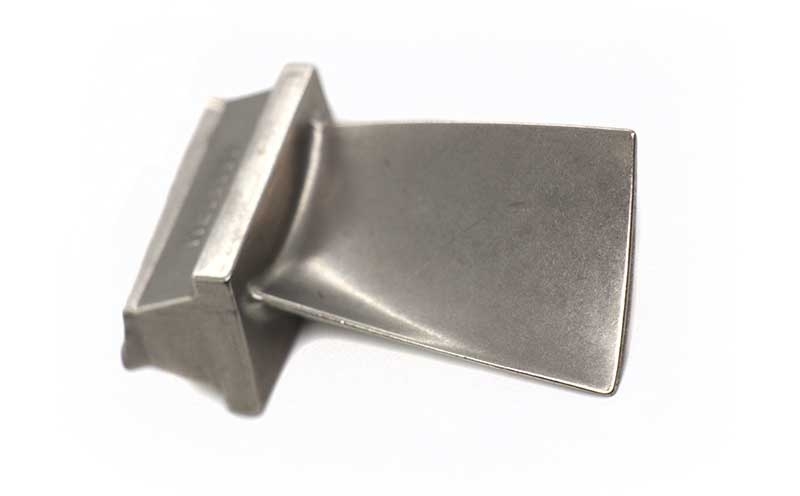
An Inconel 718 turbine blade enquiry concerns a rotating airfoil made to a defined nickel-alloy specification. Alloy 718 is age hardenable, but its strength and fatigue response depend on product form and thermal condition. The term turbine blade does not establish that 718 is suitable for a first-stage hot airfoil. ForceBeyond supports custom manufacturing and supply enquiries for the actual blade design, connecting material condition with root fit, airfoil finishing and inspection.
Scope an application-specific 718 blade. Send the rotor location, drawing, specified 718 product form and final condition, with quantities and inspection requirements. Request a custom quote.
Special Metals’ 718 bulletin describes gamma-prime and gamma-double-prime precipitation during aging. The thermal condition is part of the material definition, not an optional finishing note. Published properties must match the product form and test conditions used in the blade assessment.
| Constituent | Published range |
|---|---|
| Nickel plus cobalt | 50–55 |
| Chromium | 17–21 |
| Niobium plus tantalum | 4.75–5.50 |
| Molybdenum | 2.80–3.30 |
The producer bulletin reports these limiting ranges. They do not establish blade allowables or acceptance under a different casting or wrought specification.
The airfoil sees gas loading and vibration; its mass loads the root under rotation. Platform and tip features set other interfaces with the gas path. Root fillets, contact surfaces and the airfoil-to-root transition need the surface condition assumed by the design. A material certificate cannot replace the relationship between these finished features.
If cooling or coating is specified, its geometry and acceptance state must be included in the process plan. The blade’s location, duty cycle and local metal temperature determine the relevant properties; an alloy data-sheet range cannot serve as an engine-stage rating.
A permitted wrought, cast or customer-supplied blank has its own route and material acceptance. Stock removal must reach the specified airfoil and attachment without losing datum control. Heat treatment can be sequenced with rough and final machining to manage the drawing’s final condition, but the approved process plan determines the actual order.
Inspection planning can combine material records, hardness or mechanical tests where specified, surface NDT and profile/attachment measurements. Inspection methods must answer the acceptance questions for this part; a generic test list does not establish complete coverage.
IN 738 LC producer information concerns a different nickel alloy used in cast turbine airfoils. It does not imply that 738 is a drop-in replacement for 718, or that a 718 blade belongs in the same service. Material choice requires the actual temperature/stress cycle, product structure, coating system and approved life data.
An approved 718 blade enquiry may involve a different rotor stage, local metal temperature, form and thermal condition from a cast IN 738 LC hot airfoil. Special Metals reports condition- and test-temperature-dependent 718 properties, but those curves are not a first-stage blade rating. Gamma-double-prime and gamma-prime precipitation require the specified solution and aging sequence; a root or airfoil machined from one product form cannot inherit another form's allowables. The 718 disk instead centers on bore-rim fatigue and blank structure, while a compressor vane is stationary and may use different mounting datums.
ForceBeyond can coordinate the defined blank and finishing scope for a custom 718 blade. Program-specific source approval and capacity require confirmation. The proposal should distinguish a near-net part from a finished blade and state who owns heat treatment, coatings and final release.
For a quote, include the material and process specifications, blade drawing and model, critical surfaces, inspection package, quantity and schedule. See the blade hub for other alloy and structure topics.
No. Suitability depends on the actual stage, metal temperature, stress cycle, cooling and approved design data. The alloy name does not establish a hot-stage operating limit.
Aging changes the strengthening precipitates and resulting properties. The purchased product form and thermal condition must match the material requirements used in the blade design.
Root contact surfaces, fillets and their relationship to the airfoil and platform can be critical. Datums, surface condition and dimensional criteria belong in the finished blade drawing.
That scope can be reviewed if the blank’s pedigree, condition and allowance are known. The quote should identify remaining machining, thermal processing and release records.
Send the rotor location, drawing, specified 718 product form and final condition, with quantities and inspection requirements.
Expand this section to review the external standards, technical organizations, and reference materials used for this page.
Explore related ForceBeyond material, process, quality, industry, and manufacturing resources.