
Does titanium compressor disk use establish hot turbine suitability?
No. Compressor and turbine locations have different thermal and loading conditions. The exact alloy, rotor environment and design data must establish suitability.


A titanium turbine disk enquiry must establish which rotor the part belongs to and which alloy the design approves. Titanium alloys are documented for compressor disks, but that use does not validate a hot turbine disk. Specific strength, microstructure and cyclic behavior are grade- and condition-dependent. ForceBeyond supports custom titanium disk manufacturing and supply enquiries, coordinating a defined blank, forging or finishing scope with traceable material and the required rotor interfaces.
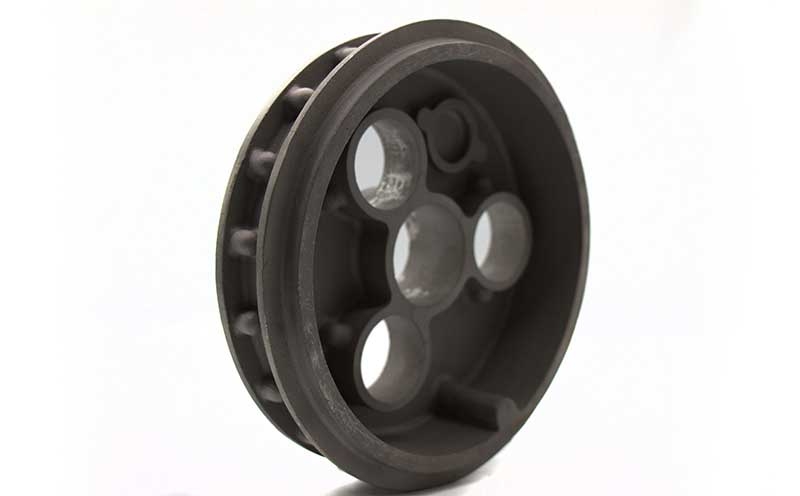
Clarify the titanium rotor application. Send the disk and assembly drawing, actual rotor location, approved titanium grade and required blank or finished-part scope. Request a custom quote.
ATI’s Ti-6Al-4V sheet lists compressor disks, blades and rings. ATI’s Ti-17 sheet identifies a beta-rich alpha-beta alloy developed for fan and compressor disks. Those references explain legitimate titanium rotor contexts. They do not establish an operating limit, life or approval for an unspecified turbine-stage disk.
First locate the disk on the engine drawing: fan or compressor rotor, a cooler turbine-related auxiliary rotor, or an actual turbine stage in the hot flow path. The ATI Ti-6Al-4V and ATI Ti-17 sheets document compressor-disk contexts, not blanket hot-section disk approval. A turbine-stage enquiry needs its own approved alloy, operating environment, rotor-life basis and material specification before a supply claim can be made.
| Reference grade | Published distinction | Engineering implication |
|---|---|---|
| Ti-6Al-4V, Grade 5 | Alpha-beta alloy; annealed or solution-treated/aged conditions | Name the final condition and product form. |
| Ti-17 | Ti-5Al-2Sn-2Zr-4Cr-4Mo; beta-rich alpha-beta disk alloy | Use its own approved forging and thermal route. |
| Generic titanium | No complete alloy or condition defined | Insufficient basis for disk life or production acceptance. |
The Grade 5 and Ti-17 producer sheets are examples, not interchangeable specifications or a material-selection approval.
Titanium working and thermal history affect the intended phase structure. Blank section size and final condition must match the material basis used by the design. Bore, web and rim thicknesses then define different machining and inspection access, with attachments and fillet transitions requiring the prescribed surface condition.
The forging and finished drawings should connect material identity, stock allowance and datums. A change of blank route cannot be justified by external dimensional similarity alone; a finished shape does not reveal the complete material structure.
Ti-6Al-4V is an alpha-beta alloy supplied in condition-dependent states; Ti-17 is a beta-rich alpha-beta alloy developed for deep hardening of larger fan and compressor disks. Their forging-temperature path, section response and final heat treatment cannot be collapsed into a generic titanium disk recipe. The design's approved phase structure and property direction should be connected to bore, web and rim test locations before machining allowance and inspection are set.
Machining must establish the bore or shaft interface, faces and attachment features while respecting the specified edge and surface requirements. Distortion and clamping of the web need consideration during stock removal. Required surface treatment and NDT follow the particular alloy and disk program.
Titanium rubbing and ignition are also design concerns in some engine environments. One NASA engine investigation associated surge-related interference with titanium combustion. This bounded example is a reason to retain approved service and contact assumptions, not a prediction that every titanium disk will fail.
The 718 disk page addresses a nickel-alloy rotor system with its own thermal and product-form requirements. Titanium’s mass advantage cannot replace evidence for temperature, fatigue, crack growth or contact behavior. The responsible design authority selects the alloy for the actual rotor location.
ForceBeyond can coordinate the defined titanium forging or machining enquiry subject to grade-specific feasibility and approval. Material records, thermal history and final inspection need to remain connected to the delivered disk.
Identify the alloy specification, rotor location, blank route, drawing revision, final condition and required records. State whether balance or other rotor verification is included, then add quantities and schedule. A customer-supplied blank needs its pedigree and incoming allowance defined.
No. Compressor and turbine locations have different thermal and loading conditions. The exact alloy, rotor environment and design data must establish suitability.
No. They have different alloy definitions and processing contexts. Each requires its own approved material form, thermal route and design properties.
Working and heat treatment influence the intended phase structure and mechanical response. A finished disk shape cannot by itself establish the material condition behind it.
The actual rotor location and approved alloy, followed by the blank route, finished drawing, final condition and acceptance package. These define a useful manufacturing scope.
Send the disk and assembly drawing, actual rotor location, approved titanium grade and required blank or finished-part scope.
Expand this section to review the external standards, technical organizations, and reference materials used for this page.
Explore related ForceBeyond material, process, quality, industry, and manufacturing resources.