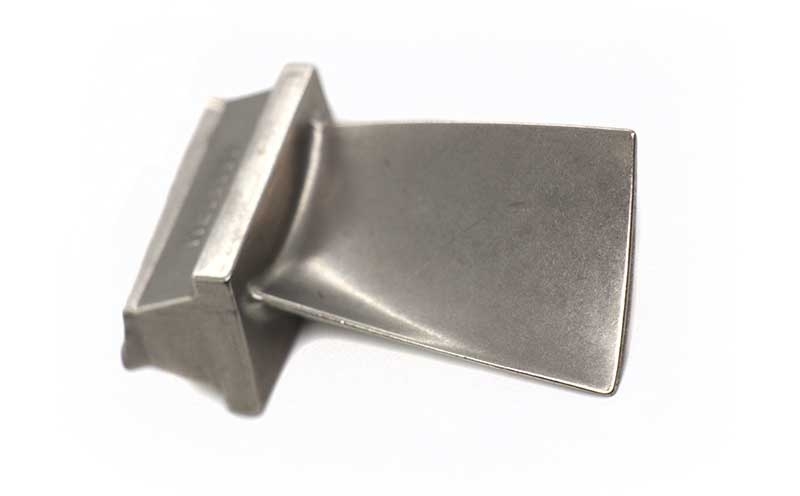
Custom René turbine blade manufacturing and supply
A René superalloy turbine blade converts hot-gas energy into rotor work while
carrying centrifugal, thermal and vibratory loads. René names a family of
nickel-base alloys, not one interchangeable blade grade: cast René 80 and
single-crystal René N5 require different processing and acceptance controls.
ForceBeyond supports custom turbine blade manufacturing and supply enquiries,
coordinating a defined casting or finished-blade scope against the customer's
material, geometry and quality requirements.
Discuss a custom René blade. Share the alloy designation, blade
drawing and required crystal structure.
Request a custom quote.
Which René alloy does the blade design require?
René 80 is described
by its producer as a precipitation-hardened cast nickel-base alloy used in blades and
vanes. Its tungsten and molybdenum additions and high gamma-prime content support
creep and tensile performance for cast blades. René
N5 is a different, rhenium-bearing single-crystal alloy developed for high-pressure
turbine blades and nozzles. The grade and crystal structure determine the casting
controls; neither name alone defines the finished blade or its operating limit.
The values come from the René 80
and René N5 producer
pages. They are nominal comparisons, not chemistry acceptance limits or evidence of
equivalent mechanical properties. Use the customer-approved grade and product
specification for a production blade.
Material limits depend on condition and service cycle
Creep is time-dependent deformation under load, while thermal fatigue follows repeated
heating and cooling. The hot airfoil and tip also face oxidation or corrosion from the
gas path; the root and platform see different contact and thermal conditions. Coatings
can protect exposed surfaces, but they do not remove the need for cooling and fatigue
assessment. Published chemistry does not supply a universal service temperature or life.
Numerical allowables require the specified cast structure and qualified test conditions.
Blade geometry: airfoil, root, platform and tip
The airfoil guides and extracts energy from the gas stream. The root retains the blade
in the disk; the platform helps define the flow path; the tip approaches the stationary
casing. Each feature imposes different dimensional and surface requirements. Where a
blade is internally cooled, passage continuity, exits and local wall geometry are
critical to the intended thermal design.
Cooling passages lower metal temperature where airflow reaches the intended surfaces,
but they also leave thinner walls and introduce openings that must retain their shape
after casting, machining and coating. The blade design balances this heat removal with
local strength and the clearance controlled by the tip. A finished-part inspection plan
therefore needs to address passage continuity and external geometry together.
In one NASA study, an air-cooled,
cast René 80 first-stage blade with an aluminide coating developed squealer-tip
creep-fatigue cracking. The observed cracks could leak coolant and raise tip temperature.
This was a specific blade design and test history, not a predicted failure mode for
every René blade. It illustrates why tip geometry, cooling and coating must be reviewed
together rather than as isolated purchase items.
From casting route to finished turbine blade
Investment casting and crystal structure
Investment casting forms the airfoil and attachment geometry; ceramic cores may define
internal cooling passages. A conventional polycrystalline casting solidifies as many
grains with grain boundaries. In a single-crystal
route described by NASA, directional solidification and a grain selector allow one
grain to grow into the blade. The resulting orientation and absence of conventional grain
boundaries are part of the intended material structure, not a cosmetic difference.
The drawing and material specification determine which route is permitted.
NASA's single-crystal inspection research
identifies orientation, stray grains and other crystal defects as acceptance concerns.
The actual criteria come from the approved blade specification; changing from a René 80
casting to René N5 requires a design decision and a different controlled process plan.
Machining, coating and inspection
After casting and prescribed heat treatment, finishing may establish the root fit,
platform interfaces and tip profile. Cooling holes and coatings have separate process
controls where specified. Inspection may include casting soundness, crystal orientation,
passage verification, dimensional records and coating checks, each tied to the selected
grade and delivery condition. ForceBeyond can coordinate the defined supply package;
processor approvals and individual capabilities must be confirmed for the program.
René 80 versus René N5: a design-specific comparison
René 80 has a
documented investment-cast blade history and high gamma-prime content. A conventional
polycrystalline version retains grain boundaries. René
N5 is specified as a rhenium-bearing single-crystal alloy; its casting route
eliminates conventional grain boundaries but brings orientation and defect controls.
These distinctions affect casting development and inspection as well as material choice.
The engine's stress cycle, cooling scheme and coating system determine what the blade
must withstand. Nominal chemistry alone cannot authorize a substitution or establish
a life advantage for a particular design.
Build the quality and supply plan around the exact blade
A casting-only package ends before root finishing, cooling-hole completion or coating
if those operations are assigned downstream. A finished-blade package brings the
casting, thermal processing, machining, coating and inspection records together.
Material heat, casting lot and process history need the traceability specified by the
customer. Airfoil and attachment datums, passage checks and coating acceptance should
correspond to the same drawing revision.
ForceBeyond can assess an enquiry for a coordinated manufacturing and supply proposal.
René grade availability, process qualifications and production capacity remain
program-specific and require confirmation before commitment.
What to include in a René blade quotation request
Send the exact René grade, blade drawing, crystal-structure requirement and desired
delivery condition, with cooling, coating and inspection requirements. Include quantity
and schedule so ForceBeyond can scope a casting or finished-blade quote. If a legacy
drawing says only "René alloy," the design authority should resolve the grade first.
René Superalloy Turbine Blade — Technical and Purchasing FAQs
Are René 80 and René N5 the same blade material?
No. René 80 is described by its producer as a cast precipitation-hardened alloy for turbine blades and vanes. René N5 is a rhenium-bearing single-crystal alloy. Their chemistry, required structures and processing controls differ, so the design authority must specify the exact grade.
Why do cooling passages and blade tips affect manufacturing planning?
Internal passages and exits depend on the approved core and hole-making route. Tip geometry controls clearance and can be sensitive to thermal cycling; a NASA René 80 blade study documented tip cracking and coolant leakage in one investigated design. Inspection must match the actual blade drawing.
How does single-crystal blade casting differ from conventional casting?
A conventional casting solidifies as multiple grains; a single-crystal process directs solidification so one selected grain grows into the blade. Orientation and unwanted grains then need inspection. Cooling, coatings and the actual service cycle still govern durability.
What is needed to quote a finished René turbine blade?
The complete alloy designation and specification, required crystal structure, blade and cooling-feature drawings, coating and heat-treatment requirements, approved sources, inspection package, quantity and delivery condition are needed for a meaningful scope review.
Request a René Turbine Blade Manufacturing Quote
Send the exact René grade, blade drawing and required casting structure for a custom manufacturing review.