
Can all stainless guide vanes use the same heat treatment?
No. Austenitic, martensitic and precipitation-hardening grades have different processing responses. The exact grade and final condition control manufacture and acceptance.


Stainless steel inlet guide vanes turn compressor-entry flow and locate the airfoil through fixed mounts or variable-vane spindles. Stainless is a family of materials with different structures, hardening routes and corrosion responses. A general stainless designation cannot establish stiffness, wear or thermal suitability for one vane. ForceBeyond supports custom guide vane manufacturing and supply with the selected grade, final condition, airfoil geometry and mounting interfaces defined together.
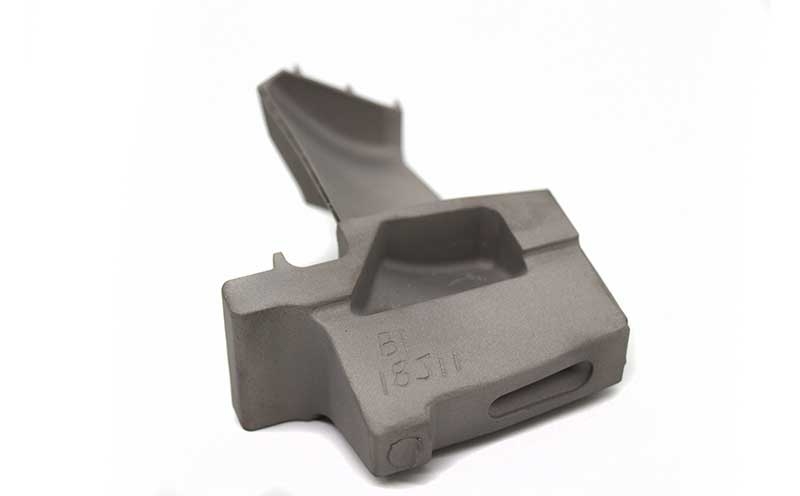
Define your stainless guide vane. Send the exact steel grade and condition, fixed or variable vane geometry, surface requirements and inspection package. Request a custom quote.
Outokumpu’s stainless-family guide distinguishes austenitic, martensitic and precipitation-hardening behavior. Their strengthening and processing routes differ, so a generic hardness or corrosion statement cannot be applied across all of them. Product form, thermal history and surface condition belong to the actual material definition.
| Family | General distinction | Question for vane manufacture |
|---|---|---|
| Austenitic | Good formability; strength can increase with cold work | Which final condition and profile stability are required? |
| Martensitic | Heat-treatable structure | How are hardness, toughness and distortion controlled? |
| Precipitation hardening | Aging changes the property combination | Which aging condition and dimensional state are specified? |
This family comparison follows producer guidance; it is not a material-selection approval or a common specification. The dedicated 17-4 PH page supplies a named-grade example.
A compressor-environment study archived by NASA discusses wet salt deposits and pitting in the investigated service region. The lesson is application-specific: ambient contaminants, shutdown moisture and cleaning practice influence material and surface decisions. It is not evidence that every steel corrodes identically or that a coating removes all risk.
Surface finish and edge condition also affect the delivered airfoil. Any coating, passivation or other treatment must be the specified process, with its effect on journals and mounting dimensions included in the final acceptance state.
Moisture and salt-bearing deposits may promote localized pitting while particle impact can remove material at leading edges; cleaning chemicals and shutdown dwell alter the exposure. These mechanisms need separate inspection and material decisions. Austenitic grades generally rely on solution/cold-work condition, martensitic grades on hardening and tempering, and 17-4 PH on precipitation aging. Passivation or a wear treatment cannot be assumed to have the same effect on every family or on a finished journal fit.
NASA’s compressor reference explains why inlet flow angle matters. In a fixed vane, mounting datums locate the airfoil. In a variable vane, spindle axis and lever clocking connect its profile to commanded position. Journal fit and profile inspection must therefore refer to the same geometry.
Thin sections can deflect under fixture or cutting loads. Roughing, thermal processing where required and final machining need a sequence that preserves profile and interfaces. Hardness alone does not verify dimensional conformance or the prescribed material condition.
A quality plan should identify material records, final condition, required NDT, profile measurements and spindle/mounting reports. These checks answer different acceptance questions. If hardware or a segment assembly is supplied, the final set and movement/fit responsibilities need explicit definition.
ForceBeyond can coordinate a defined blank and finishing proposal for the approved steel. Grade-specific capability and process approval require confirmation. Include alloy and revision, condition, assembly location, profile and journal model, surface processes, inspection records, quantities and delivery state. A loose vane and a vane with bushes or levers are different quote scopes.
No. Austenitic, martensitic and precipitation-hardening grades have different processing responses. The exact grade and final condition control manufacture and acceptance.
No. Alloy, surface condition, contaminants, moisture and cleaning environment all matter. A general family description does not establish resistance in every service.
Clocking connects the airfoil angle to its spindle and actuator interface. A profile may meet shape tolerances while being incorrectly oriented to that interface.
Final condition, fixed or variable configuration, profile/mounting datums, contact surfaces, specified treatments, inspection records and delivery hardware define the actual scope.
Send the exact steel grade and condition, fixed or variable vane geometry, surface requirements and inspection package.
Expand this section to review the external standards, technical organizations, and reference materials used for this page.
Explore related ForceBeyond material, process, quality, industry, and manufacturing resources.