
Does titanium mean Ti-6Al-4V for every inlet guide vane?
No. Ti-6Al-4V is a documented compressor-alloy example. The drawing must specify the actual approved grade, product form and final condition.


Titanium inlet guide vanes condition compressor-entry flow while providing a low-mass airfoil and support system where the approved design selects titanium. The alloy grade, phase condition and mounting arrangement influence manufacture. A fixed vane and a variable vane with journals and an actuator interface need different dimensional plans. ForceBeyond supports custom titanium guide vane manufacturing and supply enquiries with the airfoil, spindle or mounting surfaces and final material condition defined together.
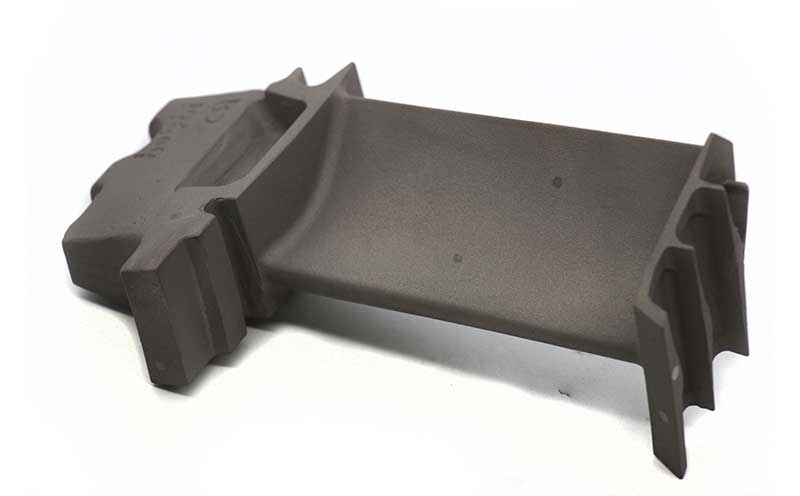
Define a titanium guide-vane package. Send the approved grade, fixed or variable vane drawing, spindle/mounting details, surface requirements and quantity. Request a custom quote.
ATI’s Grade 5 sheet describes Ti-6Al-4V as an alpha-beta alloy with annealed and solution-treated/aged conditions and compressor application context. It is one example, not the required grade for every guide vane. The final material form and condition determine which data are relevant.
| Item | Engineering relevance | Required definition |
|---|---|---|
| Alloy and condition | Phase structure and property basis | Exact grade, product form and final condition. |
| Airfoil section | Stiffness, flow angle and vibration response | Profile, thickness and edge condition. |
| Variable spindle | Installed clocking and journal fit | Axis, coaxiality and lever-interface datums. |
| Surface treatment | Contact or environmental behavior | Specified process and final dimensional state. |
No generic titanium density, strength or temperature is used as a vane acceptance value.
NASA’s compressor reference explains how inlet guide vanes turn the flow before the first rotor. In a variable design, that airfoil angle is related to the spindle and actuator interface. The journal axis, airfoil clocking and final fit must therefore belong to one measurement plan.
Thin airfoils may deflect under machining or inspection forces. Supports and fixtures must hold the part without hiding distortion. A fixed vane has no actuation journal but still needs profile-to-mount geometry and edge conditions appropriate to its installation.
A permitted forging, casting or stock-machined route must retain enough material for the final profile and supports. Thermal processing and stock removal can alter shape. The machining sequence should relate intermediate features to the final datum system while preserving the specified surface condition.
Required material records, surface NDT and profile/journal reports address different acceptance questions. Titanium machining and surface operations must follow the actual drawing; a material-family label does not establish tolerances or process qualification.
For a specified Ti-6Al-4V product form, record whether the approved condition is annealed or solution-treated and aged before using ATI's representative data. Thin airfoils can spring after stock removal or change under heat treatment; staged cuts and low-distortion fixtures should leave a final free-state profile and spindle-axis check. Journal wear surfaces or bushes need their own contact and coating requirements. The existing titanium machining and forging resources describe separate process scopes.
A NASA engine investigation connected surge-related interference with titanium ignition in one test engine. It is a bounded reminder that rub/contact assumptions matter. It does not predict failure of a particular guide vane.
The 17-4 PH vane page describes another material system with aging-condition and contact-surface considerations. Low mass, stiffness, wear and corrosion must be evaluated together; neither material is a general substitute for the other.
ForceBeyond can coordinate a defined blank or finished-vane proposal, subject to grade-specific capability and approval confirmation. Include the alloy specification, airfoil model, mounting/actuation drawing, thermal and surface condition, inspection criteria, quantities and schedule. Identify supplied bushes or levers and the customer’s downstream assembly responsibilities.
No. Ti-6Al-4V is a documented compressor-alloy example. The drawing must specify the actual approved grade, product form and final condition.
The relationship establishes the airfoil’s installed angle in a variable system. A correct external profile can still be incorrectly clocked relative to the actuator interface.
Thin sections can deflect under fixture and cutting forces. Stock removal, datum transfer and final surface/edge control need a sequence suited to the actual geometry.
A loose-vane scope can be reviewed. The quotation must identify customer-supplied hardware and the journal, clocking and mounting interfaces that remain in scope.
Send the approved grade, fixed or variable vane drawing, spindle/mounting details, surface requirements and quantity.
Expand this section to review the external standards, technical organizations, and reference materials used for this page.
Explore related ForceBeyond material, process, quality, industry, and manufacturing resources.